Rollout Context
How the Transpac Removals website was repositioned, rebuilt and migrated
Transpac Removals is a removals and restoration-support company based at 7 Forge Street, Welshpool, in Perth’s industrial south-east. It has been moving Perth offices since 1998 and has more than 25 years of experience in the industry. Over that time the business changed. Home and office moves are still part of it, but its main focus today is restoration support for insurance builders and restoration companies: moving contents out of a damaged property, storing them, protecting what stays, cleaning up after the trades and putting everything back.
The website never caught up. The brief was simple: make the website describe the business Transpac actually runs today.
The old website: a generic removalist on an ageing CMS
The previous site ran on Kentico, an ASP.NET content management system, on a Microsoft IIS server. We crawled it on 25 July 2026 and found 27 live content pages, seven of them missing from its own sitemap.
It described the wrong business. The page title Google showed read “Transpac Removals: Removalist Perth - Furniture Removalists, Removals Company”. The main heading read “Professional removalists Perth WA - your best choice of removal company”. The menu offered home removals, office removals, packing services, furniture storage and a blog. On the homepage, the words “insurance” and “restoration” didn’t appear at all.
It advertised services Transpac no longer offers. Packing and unpacking labour had been retired, but it still had its own pages. Two office services were empty pages.
It was slow and hard for machines to read. We tested the old homepage on 16 November 2026, while the old server was still answering, using the same Lighthouse version and settings as the new site. It scored a median of 57 for performance on mobile and 63 on desktop, loaded more than 1.1 MB of JavaScript, and took 8.7 seconds to show its main content on a mid-range phone. It scored 71 for accessibility, had no language declared on the page and published no structured data at all, so Google had nothing to go on beyond the text.
Three service groups, in the order customers need them
We didn’t start from the old site map. We started from the owner’s own list of services and asked a different question: who books Transpac, and what do they need to see before they call?
The answer set the order of the whole site.
Insurance services come first. Insurance builders, restoration contractors and loss adjusters need a supplier who can remove, store, protect and clean during a repair, and who understands how an insurance job runs. Nine services now sit under Insurance services, each with its own page: contents removal and reinstatement, contents storage, non-restorable contents disposal, heavy items such as pool tables and pianos, dust containment, floor, stair and balustrade protection, post-trade cleaning, fire and smoke cleaning, and high-pressure cleaning.
Home and Office removals come second. Home removals, office removals, heavy-item removals and furniture storage keep their own group and their own pages, so the household and business customers Transpac has served for decades still find them one click from the homepage.
Equipment and materials come third. Packing materials, office moving crates and HQAir Personal hydroxyl unit hire are grouped together for customers who need supplies rather than a crew.
Every job is quoted individually, so there are no prices. The site is quote-only by design. The site explains what shapes a quote, such as job size, access, storage time and disposal, and every page ends at the same enquiry form, which asks for the service and location up front so the team can reply with something useful.
The menu is organised by city. Services sit under Perth, with the structure ready to add another city once Transpac confirms which services it offers there. A service is never shown as available somewhere it isn’t.
A design taken from the logo
Transpac’s brief was bright, clean and practical, with no decorative waves. The visual identity is built from the Transpac logo: its green on clean white, deep black for contrast, and Michroma, a wide geometric typeface, for headings that read like signage on the side of a truck. Buttons carry a notched corner, and thin green route lines draw themselves across key sections as you scroll.
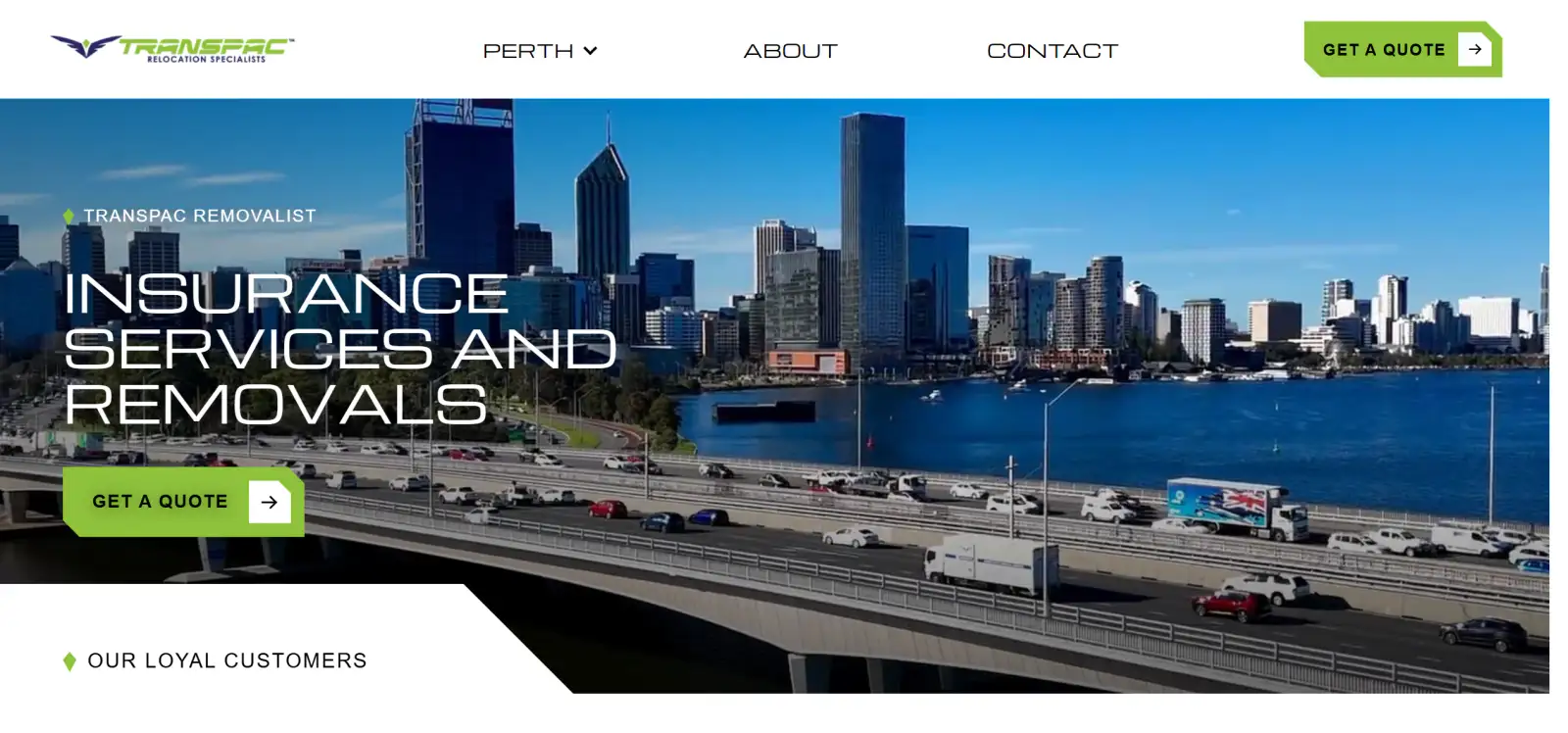
The homepage opens on a short video of the Perth skyline and the freeway beside the Swan River, placing the business in Perth before a word is read. Below it, a strip of 34 customer logos, including Coles, NAB, Perth Airport, Curtin University, Bovis Lend Lease, Frasers Property and Johns Lyng Group, does the job a paragraph of claims can’t. Job photographs come from the owner’s own projects, and customer reviews are quoted from Google word for word.
Built for speed on Transpac’s own hosting
The new site is built with Astro and hosted on Transpac’s existing cPanel account. Every page is generated in advance and served as finished HTML. Page styles are written into the HTML rather than fetched separately, fonts are self-hosted, every photograph is served as compressed WebP at the right size, and the hero video only starts once the page has finished loading, behind a preloaded poster image.
Tested on the live domain on 16 November 2026, with three runs per device:
- Mobile performance: 98 in all three runs, up from a median of 57.
- Desktop performance: 98 in all three runs, up from 63.
- Main content on screen on mobile: 1.8 seconds, down from 8.7 seconds.
- JavaScript on the homepage: 2 KB, down from 1,138 KB.
- Accessibility, Best Practices and SEO: 100 on mobile and desktop, up from 71, 57 and 92.
Built to be found on Google and by AI search
People looking for a removalist or a restoration contractor increasingly get their answer directly, from Google’s map results or from AI assistants such as ChatGPT, Gemini and Perplexity. Both favour websites that state the facts clearly, consistently and in a form machines can read. That is what generative engine optimisation (GEO) looks like for a service business.
Every page names the service and the city. Titles such as “Contents Removal & Reinstatement Perth | Transpac” and “Insurance Restoration Services Perth | Transpac” replace one title that tried to cover everything. Each page has its own description and a single main heading.
The business is described in structured data. Every page carries MovingCompany markup with the Welshpool address, phone, email, service area and a catalogue of all 16 services. Service pages add their own Service and BreadcrumbList data, and the About, Contact and category pages are marked up as what they are. All of it is generated from one data file that also feeds the pages, so the markup can never disagree with what visitors read.
The questions buyers ask are answered on the page. 87 FAQ answers across 20 pages, such as where contents go during a repair, who usually books the service and how long Transpac has been operating, are published as FAQPage data. An llms.txt file gives AI assistants a plain-language summary of the business, its services and its answers.
A careful move off Kentico
A new website shouldn’t cost a business the search traffic it already has. Before launch we combined the crawl with Google’s index and the old site’s own sitemap, then mapped every old address to its closest genuine replacement:
- 30 permanent redirects send old pages, alternate URLs, blog posts and indexed PDFs to their new homes. The old
/Home-Removals/Moving-housegoes to the new home removals page,/Office-Removals/Environmental-disposalto non-restorable contents disposal, and the oldgooglesitemap.xmlto the new sitemap. - 4 addresses return “410 Gone” on purpose. Packing labour and the empty office pages were retired, and sending them to an unrelated page would only confuse visitors and search engines.
- Every rule matches any letter case and an optional .aspx ending, because the old Windows server answered
/home-removals,/Home-Removalsand/Home-Removals.aspxalike, and links in the wild used all of them. - The redirects deploy with the site. The build writes them into the server configuration automatically, so the new site cannot be uploaded without them, and they leave the other subdomains on the same hosting account alone.
We tested all 34 on the live domain after launch, plus letter-case and .aspx variants: each old page answers with a single 301 straight to a working HTTPS page, with no chains or loops, and each retired page answers 410. It’s the same process we describe in our guide to migrating a website without losing rankings.
The result: Transpac’s website now describes the business Transpac runs. Insurance builders and restorers see their work first, home and office customers still find their way in one click, and every service has a page Google can rank and AI assistants can quote. It loads in under two seconds on a phone, scores 98 for performance and 100 for SEO, and carried every old address across in the move.
See the live site at transpacremovals.com.au, read how we built a quote-led website for another Perth contractor in the DS Hydraulic Solution case study, or find out more about our web design and development service in Perth.