
Rollout Context
Interactive website development: building an arcade on a static site
Arcade Mate is a chess YouTube channel. Each video replays a famous game, Morphy’s Opera Game, the Evergreen, Levy Rozman’s best wins, as a 1980s arcade fight, with health bars, finishing moves and a CHECKMATE! callout. Behind every video there is a research file: the sources, the moves checked and the parts of the famous story that don’t hold up.
Until November 2026 none of that had a home. Every bio pointed at YouTube, fans sent their games through chess.com, and the research stayed in a folder. arcadematechess.com fixes all three.
Why build a custom website for a YouTube channel
A link-in-bio page would have solved the first problem and nothing else. The channel needed pages that could be found in search, a way to collect fan games and votes, and something to do between uploads. Those needs pointed to a real website, but not a heavy one: most visitors arrive from a phone and leave if a page stalls.
The answer was to keep the site static wherever possible. Every page is prebuilt HTML served from Cloudflare’s edge. Only three parts talk to a server, the vote, the submission form and the puzzle high scores, and they share one Worker and one D1 database.
Game pages written for search and AI answers
There is no point competing with chess.com or Wikipedia on “Immortal Game”. The site competes on specific questions instead: who won Rozman vs Zeneli in 2024, what the key move of the Opera Game was, whether the Gold Coins story is true.
Each game page is generated from the channel’s research files. It has the video, the players with their flags, the opening, the story, three to five key moments with stills from the video, the full PGN to copy or download, and a Questions section marked up as FAQPage data. A “What we checked” section records one correction found in the sources, the kind of precise, verifiable fact that AI search tools like to quote. Each video is marked up as a VideoObject, the games index as an ItemList, and an llms.txt file lists every game with a one-line summary.
Voting, fan games and puzzles without an app
The weekly vote runs Monday to Monday with a live countdown. Visitors pick a card from a select screen, and the vote goes to D1 behind a Turnstile check. The submission form validates a PGN, checks for duplicates and rate-limits each visitor before saving it for review.
The puzzle mode was the biggest addition. It holds 22,160 puzzles from the free Lichess puzzle database, split into daily, level and theme packs that ship as static files. Moves are checked in the browser with the same rules the Worker uses, so playing costs nothing to serve. There are four modes, Daily three, Endless, Rush and Training, each with a nickname and a high-score board, and no account to create.
An arcade look that stays fast
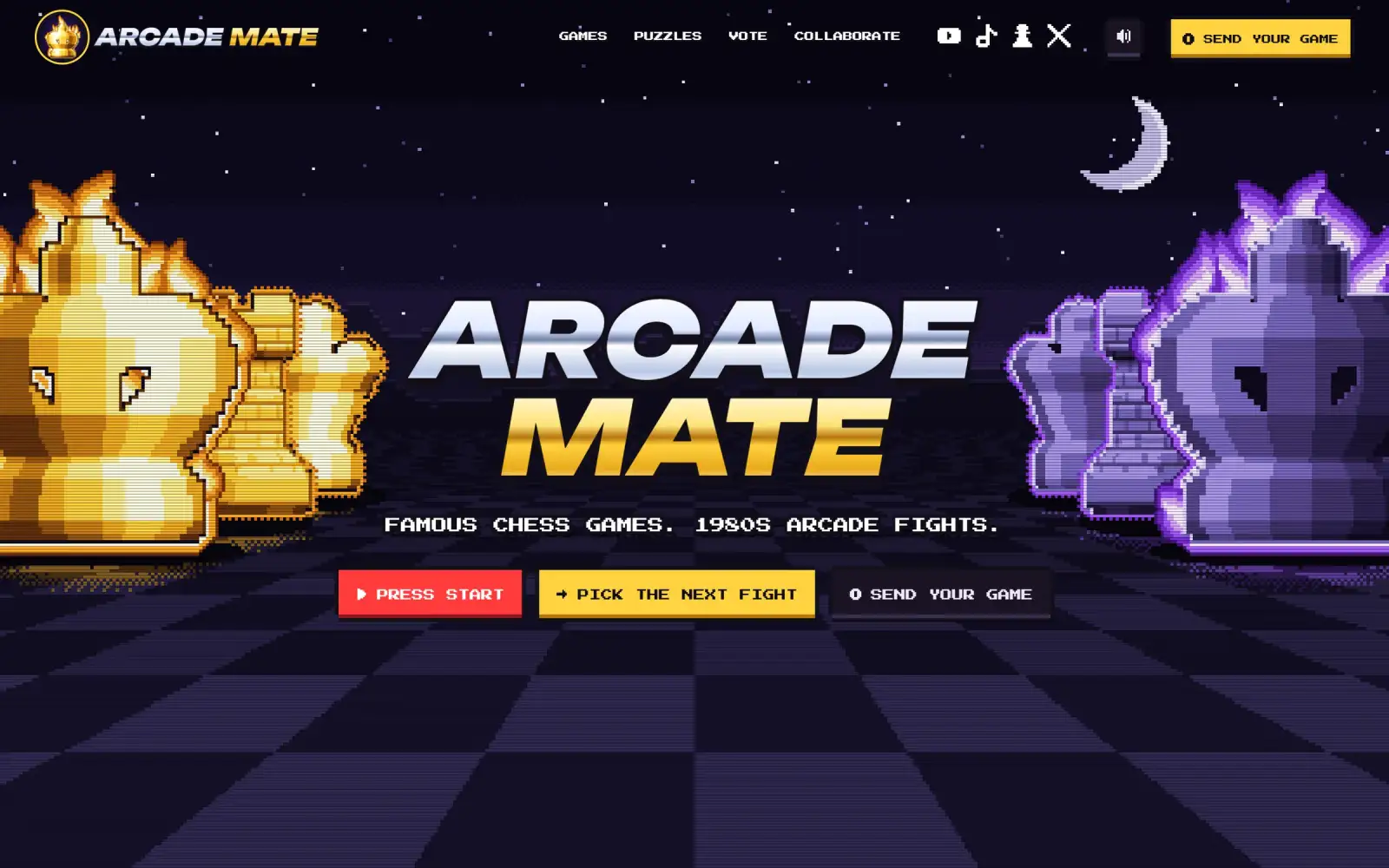
The home page opens on an attract screen. Scrolling dives through the board: it breaks, a hole opens onto a floor of lit chessboards, and the final move of a famous game plays out under the camera. Section titles slam in, numbers count up and health bars fill.
All of that motion uses transforms and opacity only, because animated masks, filters and screen shakes flickered or froze mid-scroll in testing. The effects only run in browsers that support scroll timelines, and all of them switch off for visitors who prefer reduced motion. The headline fonts are preloaded, the hero’s first frame is fetched first, and hashed files are cached for a year.
Tested with Lighthouse on 16 Nov 2026, the home page, with its animated attract screen, scores 96 for performance on mobile and 100 on desktop (the median of three runs each), with 100 for accessibility, best practices and SEO on both. It ships about 10 KB of JavaScript.
For another site built around tools people use rather than pages they scroll past, see our Vegan Hacks case study.