Rollout Context
Building a commercial contractor website that wins tender-stage enquiries
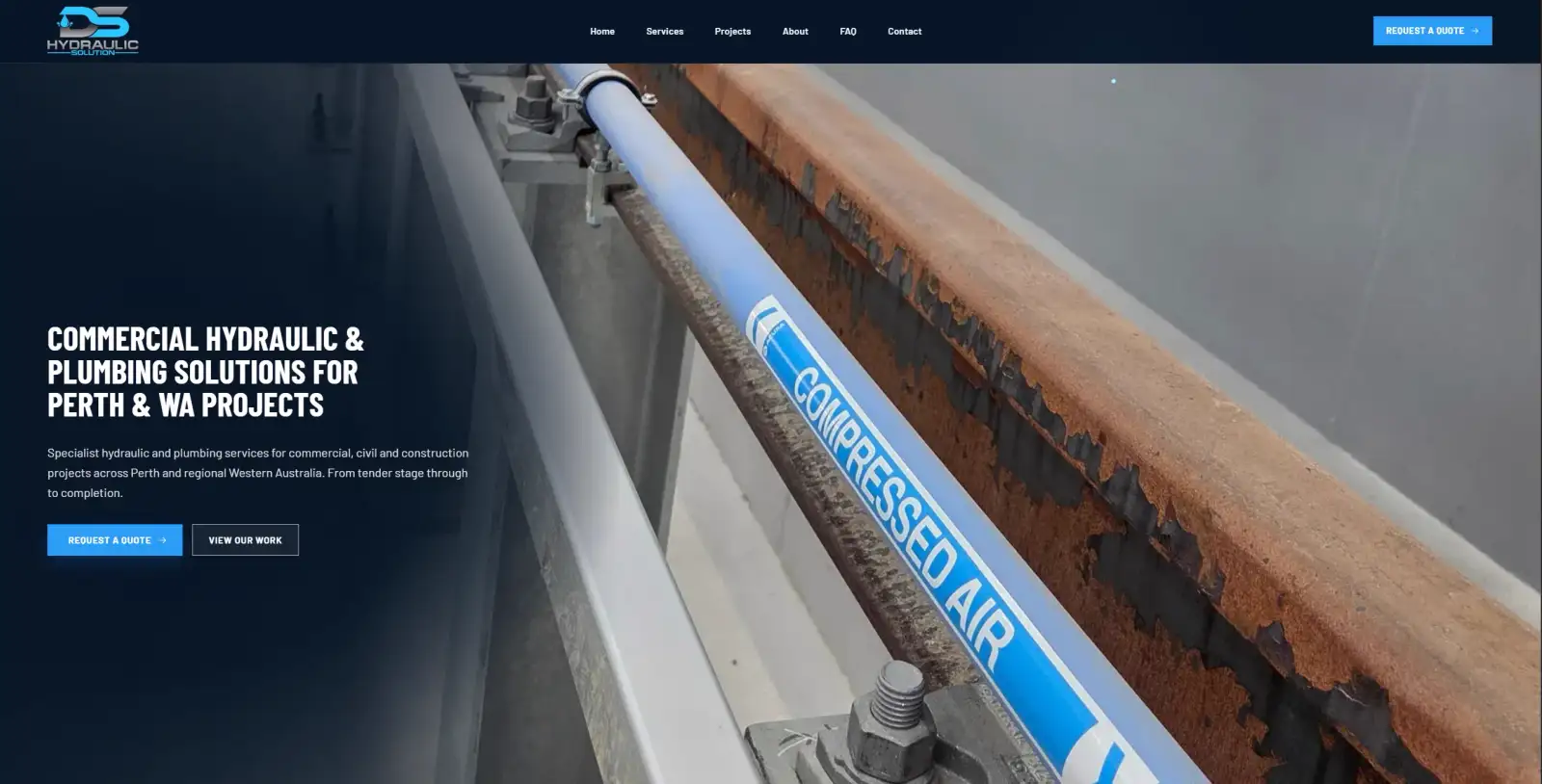
DS Hydraulic Solution is a commercial hydraulic and plumbing contractor based in Malaga, working across Perth and regional Western Australia. The work is technical, the projects are large, and the people making the decisions are builders, developers, project managers and consultants — not consumers.
This was a first website, not a rebuild. That sounds easier than it is. There was no existing site to learn from: no analytics showing what people looked for, no enquiry history revealing which questions came up first, and no established URL structure to preserve. Everything had to be reasoned from the way commercial hydraulic work is actually won.
A contractor website has a different job to a consumer one
Most trade websites are built for a homeowner with a burst pipe. That visitor wants a phone number, fast, and very little else.
Commercial hydraulic work is the opposite. A project manager evaluating a subcontractor is not making an urgent decision — they are making a considered one, often with a tender deadline attached. Before they call anyone, they want to know whether the contractor genuinely covers the required scope, whether the work meets the standards named in the specification, whether they have done comparable projects, and whether they can be trusted to coordinate on a live site without holding up the programme.
None of that fits on a homepage with a phone number and a hero image.
So the site was structured around evaluation rather than urgency. It is 20 pages: eight service pages, a projects page, a clients page, an about page with the directors named, an FAQ, a quote page, plus the supporting contact, legal and error pages. Every one of those is a static HTML page, pre-built and served finished.
Eight services, eight pages
The single most important structural decision was refusing to put the services on one page.
Drainage systems, hot and cold water services, trade waste, backflow prevention, plant room connections, compressed air, suction lines and complete hydraulic infrastructure are eight genuinely different scopes of work. They are specified separately, priced separately, and searched for separately. A single “Services” page mentioning all eight ranks properly for none of them.
Each service page carries its own scope list, the Australian Standards that govern that work, the sectors it applies to, and its own FAQs. That is not padding — it is the information a consultant needs to decide whether to include DS Hydraulic on a tender list:
- Drainage Systems cites AS/NZS 3500.2 for sanitary plumbing and drainage and AS/NZS 3500.3 for stormwater, and covers below-ground and suspended runs, floor wastes and gullies, and coordination with civil works, formwork and concrete pours.
- Backflow Prevention cites AS 2845, the standard a hydraulic consultant will name in the specification.
- Plant Room Connections cites AS 1345 for pipe identification and labelling, with commissioning and handover documentation covered explicitly.
- Compressed Air and Suction Lines cite AS 4041 for pressure piping and AS 3892 for pressure equipment installation.
Naming the standard is a small thing that does a lot of work. It signals to a technical reader that the contractor operates in their world, and it makes the page relevant to the specific language people actually search and specify in.
A quote form built for tender stage
The quote path is where most contractor websites quietly fail. They offer a name, email and “Message” box — which asks a project manager to summarise a complex commercial scope into a blank text field, usually on a phone, usually while doing something else.
We built a four-step quote wizard instead: Project → Services → Details → Contact, with a visible progress indicator so nobody is guessing how much is left.
Two decisions matter more than the step count.
The form branches. Choosing a project type reveals a relevant sub-type, and that reveals a relevant project stage, and the stage determines which fields appear next. Someone at tender stage is asked about the tender deadline and whether design documentation exists. Someone with an urgent site issue gets a very different set of questions. Nobody scrolls past fields that don’t apply to them. Hidden fields are properly disabled rather than merely hidden, so they never submit stale values and screen readers never announce them.
Every field accepts “Unknown”. This is the detail we would defend hardest. Real enquiries arrive incomplete — the programme window isn’t confirmed, the drawings aren’t issued, the required date depends on another trade. A form that demands certainty either turns those enquiries away or teaches people to invent answers. Placeholders throughout say “Unknown / not decided yet” in as many words. An enquiry with three unknowns and a real phone number is worth far more than no enquiry at all.
The result is a form that captures project type, stage, required services, location, timing, documentation status and contact preference — a genuine brief rather than a name and a sentence — while still being answerable by someone who is halfway through their day.
Built for how project people actually search
Search behaviour in this sector splits in two directions, and the site had to serve both.
Some searches are by service and location: commercial drainage, backflow prevention, trade waste in Perth or WA. Those land on the relevant service page, which is why each of the eight has its own address, its own title, its own description and its own keyword focus.
Other searches are by sector: a builder looking for a hydraulic contractor with multi-residential experience, or mining and resources experience, or defence project experience. Those are answered by dedicated sector messaging and by the projects and clients pages, which give the claims something concrete to stand on.
Underneath both, the site carries structured data on every page — Plumber as the local business type, with Service and BreadcrumbList markup on service pages and FAQPage markup on the FAQ and service FAQs. This is the machine-readable layer that lets Google and AI assistants answer “who does commercial trade waste in Perth” without having to interpret marketing copy correctly.
Fast because of how it was built, not because it was optimised afterwards
Across all 20 pages, the site ships one JavaScript file of roughly 4.2 KB — and that file exists only to drive the process section animation. The quote wizard’s branching logic is a small inline script on the page that needs it. Everything else is HTML and CSS.
That is not the outcome of a performance sprint. It is what happens when a site is built as static pages rather than assembled in the visitor’s browser by a page builder or a heavy theme. Fonts are self-hosted through @fontsource rather than fetched from Google’s servers, which removes two extra connections before any text can render. Images run through Astro’s image pipeline and are served as WebP at the size the device actually needs.
The practical consequence: a project manager opening the site on site, on mobile data, on a phone that is three years old, gets a usable page immediately. That is a normal condition in construction, not an edge case.
Perth-built for Western Australian projects
The visual direction is deliberately industrial — dark navy, a technical grid, blue linework and yellow highlights — because generic marketing imagery does hydraulic infrastructure no favours. The contrast is held high around service links, proof points and quote actions, so the technical aesthetic never costs the site its clarity.
The practical details stay visible throughout: the Malaga base, Perth metro and regional WA coverage, the directors by name, and direct contact routes alongside the structured quote path.
The result: a commercial contractor with a website that matches the technical seriousness of the work. Twenty pages, eight dedicated service pages naming the standards each scope is built to, a branching four-step quote wizard that accepts incomplete answers, structured data throughout, and 4.2 KB of JavaScript across the whole site.
If you run a contracting or project-led business and your website is a single page of services with a contact form underneath, the gap is rarely design. It is that the site was never structured around how your clients actually evaluate you.
Read more about DS Hydraulic Solution or explore our Web Development Perth service.