Rollout Context
What the Body Therapy migration proves about healthcare web development
Body Therapy Chiropractic is a busy clinic in Chatswood on Sydney’s Lower North Shore. The care was excellent. The website was not.
Their old Squarespace site was slow to load, looked several years behind the clinic it represented, and made visitors work to find the two things they actually wanted: whether this practice could help with their specific problem, and how to book. The clinic was already winning the hard part — it ranked on page one in Chatswood for its main searches — and then handing those visitors an experience that undersold it.
That’s the expensive kind of problem. Traffic you’ve already earned, leaking at the last step.
Why a slow website costs you patients
People are unforgiving about speed, and they’re most unforgiving on a phone. A page that takes a few seconds to become useful loses a meaningful share of visitors before they’ve read a single word — and health searches are often urgent, one-handed, and done on mobile data.
Website builders make this worse by design — Squarespace, Wix, GoDaddy and Weebly all work the same way. To offer drag-and-drop editing, they ship a large amount of JavaScript to every visitor and assemble the page in the browser after it arrives. You pay that cost on every single visit, forever, for convenience that only ever benefited whoever built the site. It’s also a ceiling you can’t lift: no amount of tidying up your Squarespace template removes the platform’s own overhead.
We took the opposite approach. The new site is fully static, meaning every page is built in advance and served finished. Across all 141 pages there is exactly one JavaScript file, and it’s 4.6 KB — smaller than a single small photo, and it exists only to control the homepage video. The menus, the FAQ accordions and the language switcher all work without any JavaScript at all.
It shows in Google’s own test. Re-run on 27 September 2026, Lighthouse scores the homepage 96 for performance on mobile and 100 on desktop (the median of three runs each), and the main content appears in 2.4 seconds on its simulated mid-range phone over slow 4G.
Getting there was deliberate work, not a lucky score:
- Fonts are self-hosted. The old site fetched fonts from Google’s servers, adding two extra connections before any text could render. Now they ship with the site and the two most important ones are preloaded.
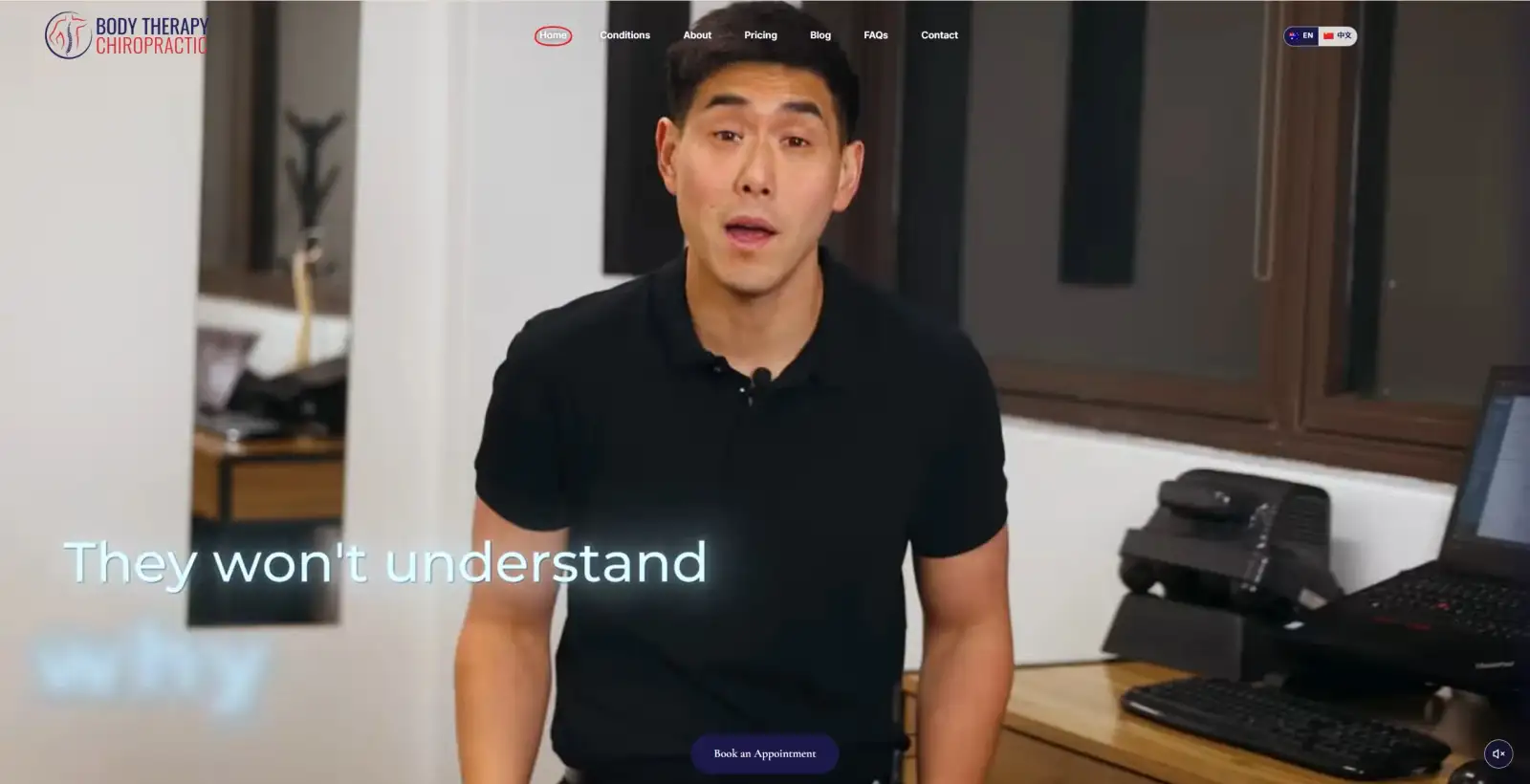
- The hero video never blocks the page. It holds a lightweight image poster and only starts loading after the page is usable, with a separate smaller version encoded for phones. The video is a feature, not a tax.
- Images are modern and responsive. Every image is converted to WebP and served at the right size for the device, so a phone never downloads a desktop-sized file.
- Only the CSS a page needs gets sent, split per section of the site rather than shipped as one giant stylesheet.
Migrating off Squarespace without losing rankings
This is the part that makes clinics nervous, and rightly so. A careless migration is one of the fastest ways to erase years of SEO progress: old URLs die, Google finds dead ends, and rankings that took years to build evaporate in weeks.
We handled the whole move ourselves — the redirects, the DNS, the hosting and the SSL certificate. The clinic didn’t have to coordinate between a designer, a domain registrar and a host, which is exactly where migrations tend to fall apart.
We didn’t guess at the old URL structure — we pulled the old Squarespace sitemap and mapped it, page by page. That produced more than 50 redirect rules, each pointing an old address at its correct new home: old contact and practitioner pages, twelve condition pages, six separate health fund pages consolidated into one better page, and a set of old suburb pages routed to their nearest equivalent.
Where a page’s address hadn’t changed, we deliberately wrote no rule at all. That sounds obvious, but it’s precisely where migrations break — a redirect pointing a page at itself creates an infinite loop, and the page becomes unreachable. We hit exactly that on two pages during the build, fixed it, and left a written explanation in the code so nobody reintroduces it later.
The blog moved across untouched. All 31 articles kept their original addresses, which means they kept their existing search equity outright.
Moving the domain, the DNS and the hosting
Redirects only work if the domain is actually pointing at the new site. That means moving DNS — the settings that tell the internet where to find a website — off Squarespace and onto the new host, and it’s the step where migrations go visibly, publicly wrong.
The risk people underestimate is email. DNS doesn’t just route your website; the same settings route your mail. Change them carelessly and the clinic’s email stops working the same afternoon the new site goes live — no appointment confirmations, no patient enquiries, and often no obvious explanation. So before touching anything we recorded every existing DNS record, identified which ones belonged to email and other services, and carried them across untouched.
The cutover itself ran in a deliberate order:
- Build and test the new site on a temporary address first, so it was fully working and verified before the domain pointed anywhere near it.
- Shorten the DNS caching window ahead of the switch, so the change propagates in minutes rather than lingering for a day or more.
- Preserve the email and verification records, keeping the clinic’s mail flowing throughout.
- Repoint the domain to the new host, with the SSL certificate issued and the secure padlock live immediately — no browser warnings, not even briefly.
- Keep the old site available until propagation completed, so nobody landed on an error while their internet provider caught up.
- Verify from the outside afterwards: redirects tested one by one, the new sitemap submitted to Google Search Console, and crawl errors watched over the following weeks.
The clinic’s staff had nothing to do on the day. The site changed, the email kept working, and the padlock never disappeared.
We do this for every migration, and it’s genuinely platform-agnostic — Squarespace, Wix, Shopify, GoDaddy, Weebly, Webflow, Joomla or a tired old WordPress install. The old platform changes which quirks we plan around; the discipline behind the move doesn’t change at all.
A design built around how patients actually decide
The redesign wasn’t a coat of paint. It was a restructure around the sequence a patient moves through: what’s wrong with me → can these people help → who will treat me → what will it cost → how do I book.
Every condition gets its own page. Back pain, neck pain, headaches, migraines, posture, sports injuries, shoulder pain, hip pain, herniated discs, strains and sprains, chronic pain and arthritis — twelve pages, each written for someone searching for that specific problem. Someone typing “back pain chiropractor Chatswood” now lands on a page about back pain, not a homepage that mentions it in passing.
Pricing is upfront and unambiguous. Three clearly presented consultation fees, plus every accepted private health fund shown with its logo. Hidden pricing doesn’t create enquiries; it creates hesitation.
The practitioners are real people. Full profiles, actual clinic photography instead of stock images, university qualifications, and AHPRA registration presented as a verifiable credential rather than a line of fine print.
Booking is never more than one tap away. The booking system is embedded directly in the site, with a persistent “Book an Appointment” button and a low-commitment free 15-minute chat option for people who aren’t ready to commit to a consultation.
The visual identity was rebuilt from the clinic’s own logo — a deep navy paired with a clear red accent, an elegant serif for headings, and generous spacing. It reads as a healthcare practice you’d trust, which is exactly the job.
The bilingual advantage the old site was wasting
Chatswood has one of Sydney’s largest Mandarin and Cantonese speaking communities. Body Therapy Chiropractic’s practitioners speak both. The old Squarespace site mentioned this almost in passing.
So we built the entire website twice. Seventy-one pages in Chinese, mirroring the English site: every condition, every practitioner, the pricing, the FAQs, the suburb pages. Not a translate widget bolted on top, but real pages with their own addresses that Google can index and rank on their own merit.
Three details matter here, and they’re where most bilingual sites fall down:
The copy is written, not machine-translated. It carries the same careful AHPRA-compliant language as the English — assessment, personalised care, no promised outcomes — rather than the slightly-off marketing tone that automatic translation produces.
Chinese text is typeset properly. The elegant fonts chosen for English simply contain no Chinese characters. The site switches to a proper Chinese type stack automatically and adjusts how headings wrap, because Chinese text breaks differently to English.
A Chinese page is only published when it’s genuinely ready. Each page carries a flag saying whether its translation is live. Until it is, the language switcher hides the link and Google is told nothing about it — because pointing search engines at a translation that doesn’t exist yet is worse than not mentioning it at all.
None of this depends on anyone remembering to check. An automated test runs every time the site is published and refuses to publish if a Chinese page has lost its English counterpart, if the language signals don’t match up in both directions, if the switcher doesn’t link to the right page, or if the Chinese homepage accidentally links back into the English site. If the translation system breaks, the site doesn’t go live. It simply cannot ship broken.
Built to be found by Google and by AI
Search increasingly means AI assistants answering questions directly, not just a list of blue links. Both need the same thing: facts they can read without guessing.
Every page carries structured data — machine-readable detail about the business, its address, hours, services, practitioners, prices and FAQs — all cross-linked so Google understands they describe one clinic, not scattered fragments. The practitioners’ AHPRA registrations are marked up as formal professional credentials, naming the regulator, which turns a claim of legitimacy into something verifiable.
We also publish a plain-language facts file specifically for AI crawlers: address, phone, hours, fees, health funds, languages spoken by each practitioner, and areas served. When someone asks an AI assistant for a Mandarin-speaking chiropractor in Chatswood, the answer shouldn’t depend on it correctly interpreting marketing copy.
Working inside healthcare advertising rules
Chiropractic is AHPRA-regulated, and the rules are strict: no promised outcomes, no “cures” or “fixes”, and no patient testimonials about clinical care in your own advertising.
That last one is genuinely awkward, because reviews are how most local businesses build trust. Our solution keeps the clinic firmly on the right side of the line: the site pulls the clinic’s Google rating and review count when the site is built and displays only those numbers, linking to Google for the reviews themselves. The review text is never reproduced on the site, and the API key that fetches it never reaches the browser.
Credibility instead comes from things that are permitted and, frankly, more convincing: named practitioners, real qualifications, verifiable AHPRA registration, and a visible “Reviewed by James Zheng” byline on every condition page with the review date recorded in the page’s structured data.
Built so the clinic can grow it
The site’s content lives in structured data files, separate from the page designs. Adding a new suburb page means adding one entry — and the page, the navigation link, the breadcrumbs, the FAQ markup, the sitemap entry and the Chinese counterpart all generate themselves.
The clinic’s address, phone and hours exist in exactly one place, and every page, the footer, the contact page and all the structured data read from it. Inconsistent business details across a site are a well-known local SEO problem; here it’s structurally impossible. When a commissioned SEO audit turned up an address that had been wrong for two years, correcting it everywhere was a one-line change.
That architecture is why the clinic’s content plan — 22 articles between August and December 2026 — is data entry rather than a development project.
Perth-built, Sydney-deployed
We’re based in Doubleview in Perth’s western suburbs. Body Therapy Chiropractic is in Chatswood, roughly 3,300 kilometres away, and the entire project ran remotely.
That’s normal for us. Web design and development doesn’t require sitting in the same room, and we work this way with clients across Australia — Perth, Sydney, Melbourne, Brisbane, Adelaide and regional areas. What matters is a clear brief, honest communication, and someone who understands both the technical build and the search consequences of every decision in it.
The result: a clinic that was already ranking now has a website worthy of that traffic. 141 pages, 71 of them in Chinese, running on a single 4.6 KB script, with every old URL safely redirected, the DNS and hosting moved without a minute of downtime, and the whole thing built to grow.
If you’re on Squarespace, Wix or any other website builder and you’ve been putting off a rebuild because you’re worried about losing your Google rankings — that’s the part we handle, and it’s the part we’re careful about.
See the live site at Body Therapy Chiropractic, or read more about our Web Design & Development service.