Rollout Context
Why the Fiski project matters beyond launch
Fiski makes swimming goggles for Australian swimmers and sells them direct through its own online store, under the line “Swim with Confidence”. The range runs from the everyday Hunter through the Racer built for starts and turns, into prescription goggles for swimmers who need correction in the water, and a kids line.
That combination sets a high bar for photography: when someone can’t pick the product up, turn it over and hold it against the light, the images have to do all of that work for them.
Goggles are genuinely one of the hardest things to photograph in a studio, and the reason is simple physics. A goggle lens is a small, curved, highly polished mirror. Point a camera at it and you don’t just photograph the goggles — you photograph the softbox, the light stands, the ceiling, the camera and the photographer holding it, all wrapped and distorted across the lens surface. On a curved surface those reflections stretch across the entire lens, so there’s nowhere for them to hide.
Most attempts at this end one of two ways. Either the lens is full of visible studio clutter, which looks amateurish and hides the actual product. Or the lighting gets flattened right down to kill the reflections, which strips out the shine and gloss that makes the goggles look good in the first place — and on a mirrored lens, removes the entire reason someone chose that finish.
Every lens in the range behaved differently
The range made this harder still, because it isn’t one lens type repeated in different frame colours.
The smoke tinted lenses are relatively dark and fairly even, so the challenge is keeping them from reading as flat black holes while still showing they’re tinted.
The blue and purple tinted lenses carry real colour that has to stay accurate. Tinted transparent surfaces drift easily under studio light — a blue lens photographs grey or turns warm and purple with very little provocation.
The iridescent mirrored lenses are the difficult ones. Those coatings change colour depending on the angle they’re lit and viewed from, shifting through green, orange, blue and silver. Light them casually and you get an unrecognisable muddy sheen. Light them properly and you get exactly what the customer is paying for.
The frames added a second problem on top. The range runs from pure black to pure white, and both had to sit on the same bright white background. Black frames tend to lose all their edge detail and turn into silhouettes; white frames tend to dissolve into the background entirely. Both need separation and shape, in the same shoot, with consistent treatment.
Controlling what the lens can see
The approach was to treat each reflection as something to design rather than something to eliminate.
Because a curved lens reflects its surroundings, the way to control it is to control the surroundings. Large shaped light sources placed at worked-out angles mean that what each lens reflects is a clean, intentional gradient — not a photograph of the studio. The lens still reads as glossy and reflective, because it is, but what it’s reflecting is deliberate.
Camera position was solved per product rather than locked once and reused. A few degrees of difference changes what a curved surface throws back, so each pair was positioned individually to keep the highlight where it belonged and the branding readable. Frames and lenses were also lit with separate consideration, so black frames kept their edges, white frames stayed separated from the background, and the lens tint stayed accurate in the same exposure.
For the mirrored lenses specifically, the goal was to let the iridescence run across the lens as a visible feature — a genuine colour shift from green through orange and blue — rather than freezing it at one flat angle.
Building the library the store actually needs
Beyond solving the lighting, the shoot had to produce the specific images an online store runs on.
Hero frames for each colourway show the frame, the lens tint and the strap in a single readable image — the main product-page shot.
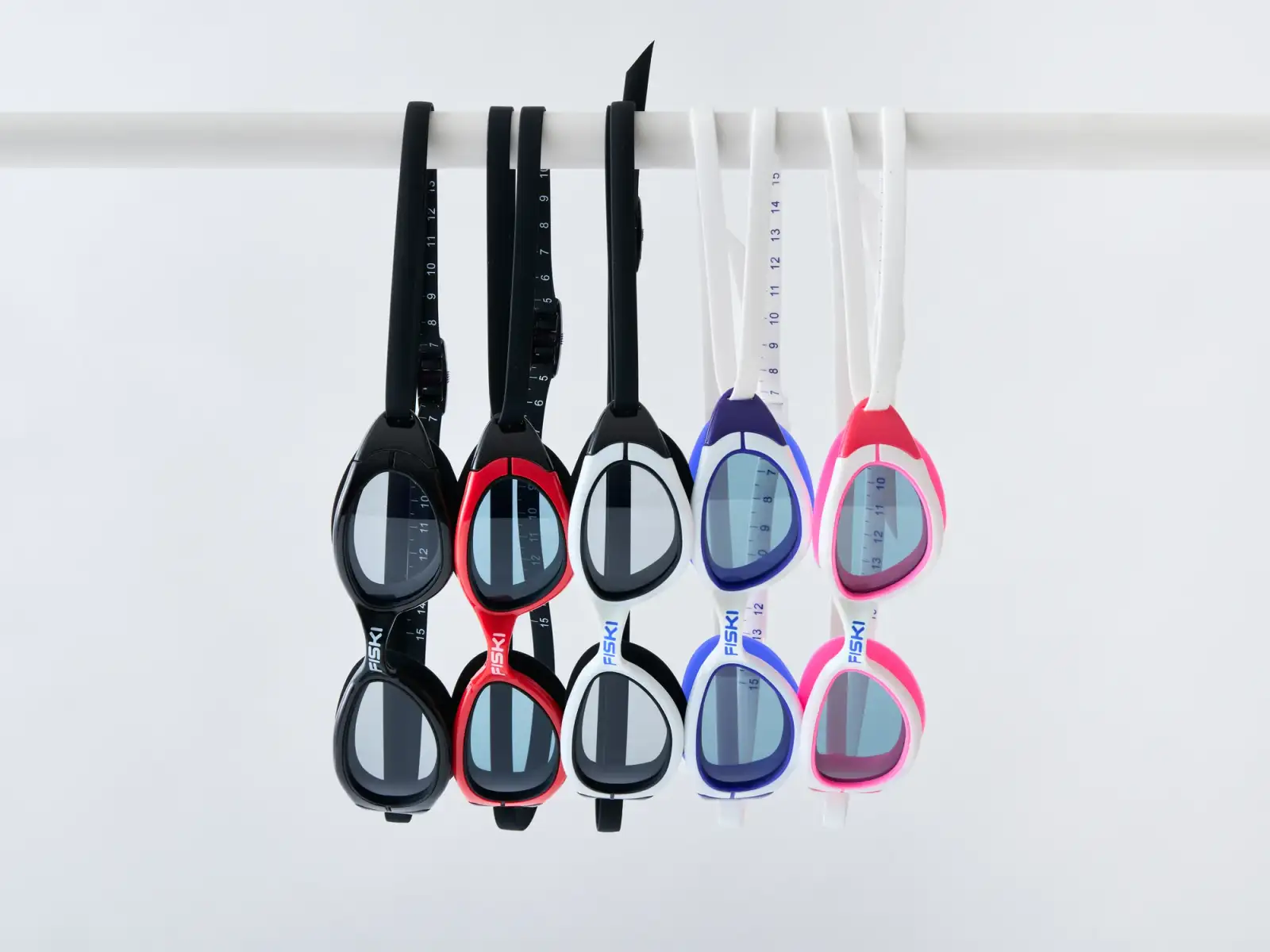
Range group shots hang the full line-up together, letting a customer compare every colour and lens finish in one glance. These earn their keep on category pages and in campaigns, where the breadth of the range is the message.
Detail frames cover what people actually worry about before buying goggles online: the softness of the silicone eye gaskets, the split-strap design, the nose bridge, and the numbered adjustment markings that show the fit is tunable. Comfort and fit are the two reasons goggles get returned, so those frames do real work in reducing hesitation.
Fit detail matters more for Fiski than for most brands, because the range includes prescription goggles. A swimmer buying corrective lenses online is making a considered purchase and will study the images closely before committing — so the frames showing gasket shape, strap adjustment and how the goggles sit in the eye socket have to be unambiguous.
Everything was graded consistently and exported web-ready, so the range looks like one coherent collection rather than a set of separate shoots.
The result
A complete ecommerce library where every pair looks like itself. The mirrored lenses show their iridescence, the tinted lenses hold their true colour, the black and white frames both keep their shape on a white background, and not one lens reflects a light stand.
That’s the whole job with reflective products: the difficulty should be invisible in the final image. A customer scrolling the Fiski store shouldn’t be thinking about lighting at all — they should just be deciding which colour they want.
Reflective and transparent products are a specialty rather than a problem for us. If you sell eyewear, glassware, chrome, polished metal, jewellery, packaging film or anything with a screen, see our Product Photography Perth service or browse Fiski to see the range in use.