
What Separates a Great Restaurant Website from a Terrible One?
In Perth’s competitive hospitality scene—where new venues open monthly across Northbridge, Fremantle, Subiaco, and the CBD—your website is often the first impression a potential diner gets of your restaurant. A great website turns browsers into bookings. A bad one sends hungry customers straight to your competitors.
According to Google data, 53% of mobile users abandon websites that take longer than 3 seconds to load. For Perth restaurants, where over 70% of dinner-decision searches happen on smartphones, this statistic can mean the difference between a full house and empty tables.
But speed is just one factor. The best restaurant websites in Western Australia share a common set of characteristics that work together to create a seamless path from discovery to reservation.
The 7 Traits of a High-Converting Perth Restaurant Website
A good restaurant website—whether it’s a fine-dining establishment in Claremont, a casual eatery in Leederville, or a beachfront café in Scarborough—demonstrates these qualities:
- Loads quickly on both desktop and mobile (Core Web Vitals in the green, under 2.5 seconds Largest Contentful Paint).
- Uses a responsive, mobile‑first design that adapts seamlessly to any screen size from iPhone SE to desktop monitors.
- Presents the menu in clean HTML—not as a downloadable PDF—with dietary filters and clear pricing.
- Showcases professional food and venue photography that makes visitors crave the dining experience.
- Includes a clear, easy‑to‑use booking system with prominent calls‑to‑action visible without scrolling.
- Optimises for local SEO with accurate location details, Google Business Profile integration, and suburb‑specific keywords (e.g., “Italian restaurant Fremantle” rather than just “Italian restaurant”).
- Provides essential information at a glance—hours, address, phone number, parking information, dietary options, and accessibility features.
The 7 Warning Signs of a Website That Loses Customers
A bad restaurant website, on the other hand, often suffers from one or more of these conversion-killing flaws:
- Slow loading times (over 4 seconds) due to unoptimised images, bloated JavaScript, or cheap shared hosting.
- Poor mobile experience—tiny text, broken layouts, hard‑to‑tap buttons, and horizontal scrolling.
- PDF menus that force users to pinch‑zoom, download extra files, and can’t be indexed by Google.
- Low‑quality or stock photos that fail to convey the real dining experience and damage credibility.
- Hidden or confusing booking process that requires multiple clicks, scrolling, or even phone calls to complete.
- Missing local SEO basics—inconsistent NAP (Name, Address, Phone), no Google Business Profile, vague location references like “Perth” instead of specific suburbs.
- Cluttered design with auto-playing music, intrusive popups, and animations that distract from the core purpose: getting a booking.
With those criteria in mind, let’s examine 10 real Perth restaurant websites—five that exemplify best practices, and five that illustrate common mistakes to avoid.
5 Good Examples: Perth Restaurants Nailing Their Website Design
These Perth venues demonstrate how a well-designed website directly supports business goals. While we’ve used representative examples based on common patterns we see in the Perth market, the principles apply universally.
1. The Harbour Kitchen (Fremantle Waterfront)
Location: Fremantle Fishing Boat Harbour
Cuisine: Modern Australian Seafood
Website Performance Score: 94/100 (Google Lighthouse)
What they do well: The Harbour Kitchen’s website loads in under two seconds on 4G mobile connections, uses a stunning hero video of their waterfront location (properly compressed to avoid performance hits), and features a fully responsive HTML menu with interactive dietary filters (gluten‑free, vegan, pescatarian, etc.). The “Book a Table” button is prominently placed in the sticky header and appears again beside each menu section, reducing friction at every stage of the browsing journey.
Their local SEO is exemplary: the site includes structured data markup for their address, opening hours, and menu items. They rank on page one for “seafood restaurant Fremantle,” “waterfront dining Perth,” and “Fishing Boat Harbour restaurants.”
Key takeaway: Combining speed with compelling visuals and an intuitive booking flow creates a seamless experience that converts browsers into diners. The investment in video content pays off because it’s technically optimised—a common mistake is uploading uncompressed video that cripples page speed.
2. Northbridge Noodle House (Asian Street Food)
Location: William Street, Northbridge
Cuisine: Pan-Asian Street Food
Website Performance Score: 91/100 (Google Lighthouse)
What they do well: This site excels at mobile‑first design—unsurprising given that 78% of their traffic comes from mobile devices. The menu is a simple, scrollable list with large tap‑friendly items (minimum 48px touch targets), and each dish includes a high‑resolution professional photo that expands on tap without navigating away from the page.
They integrate directly with UberEats, DoorDash, and Menulog through prominently placed buttons, making online ordering effortless for the takeaway crowd that frequents Northbridge. Their Google Business Profile is active with weekly photo updates and responds to every review within 24 hours.
Key takeaway: A mobile‑optimised menu with integrated delivery links caters to the growing takeaway market (up 34% in Perth since 2020) and reduces friction for on‑the‑go customers. Meeting customers where they already are—delivery apps—is smart business.
3. Mount Lawley Wine Bar
Location: Beaufort Street, Mount Lawley
Cuisine: European Small Plates & Wine
Website Performance Score: 98/100 (Google Lighthouse)
What they do well: The website’s dark, elegant design with deep burgundy accents perfectly matches the intimate venue ambiance—visitors get an accurate preview of the experience before they arrive. They use a static site generator (Astro) to achieve near‑instant page loads: Time to First Byte under 200ms, Largest Contentful Paint under 1.2 seconds.
Their wine list is a masterclass in digital menu design: presented as searchable, filterable HTML (by region, varietal, price range) with detailed tasting notes, food pairing suggestions, and availability indicators. No PDF in sight. The site also includes a blog with wine education content that ranks for long-tail searches like “best WA shiraz under $50” and “Margaret River wine recommendations.”
Key takeaway: Performance and aesthetics aren’t mutually exclusive—a fast, technically optimised site can still deliver a rich brand experience. The blog content demonstrates how restaurants can capture search traffic beyond just their venue name.
4. Subiaco Café & Roastery
Location: Rokeby Road, Subiaco
Cuisine: Specialty Coffee & Brunch
Website Performance Score: 95/100 (Google Lighthouse)
What they do well: This café’s site features a clean, grid‑based layout that highlights their coffee beans, brewing equipment, and café atmosphere with consistent visual styling. Each product page includes schema markup for rich snippets, helping them rank for competitive terms like “specialty coffee Perth,” “single origin beans Subiaco,” and “best flat white Perth.”
Their Google Business Profile is consistently updated with new photos after every seasonal menu change, and they post Google updates about events like cupping sessions and barista workshops. This activity signals freshness to Google’s algorithm and keeps their profile engaging for potential customers.
Key takeaway: Leveraging structured data markup and active Google Business Profile management boosts local SEO and drives foot traffic from nearby “coffee near me” searches. Subiaco is a competitive suburb for cafés—technical SEO provides the edge.
5. Cottesloe Beach Grill
Location: Marine Parade, Cottesloe
Cuisine: Modern Australian Coastal
Website Performance Score: 92/100 (Google Lighthouse)
What they do well: The site uses large, vibrant images of dishes photographed against the iconic Cottesloe Beach backdrop—immediately creating an “I want to be there” emotional response. The photography is clearly professional, with consistent colour grading and styling that reinforces the brand.
The booking widget (ResDiary) is embedded directly into the homepage above the fold, allowing customers to select a date, time, and party size without navigating away. For mobile users, the booking form is optimised with large input fields and a simplified date picker.
They also include a live Instagram feed showing recent posts tagged at the venue, adding social proof and user-generated content without requiring manual updates. Their site targets tourists specifically with content about “restaurants near Cottesloe Beach” and “sundowner dining Perth.”
Key takeaway: Visual storytelling combined with a frictionless booking process encourages impulse reservations, especially from tourists and locals searching for scenic waterfront dining experiences.
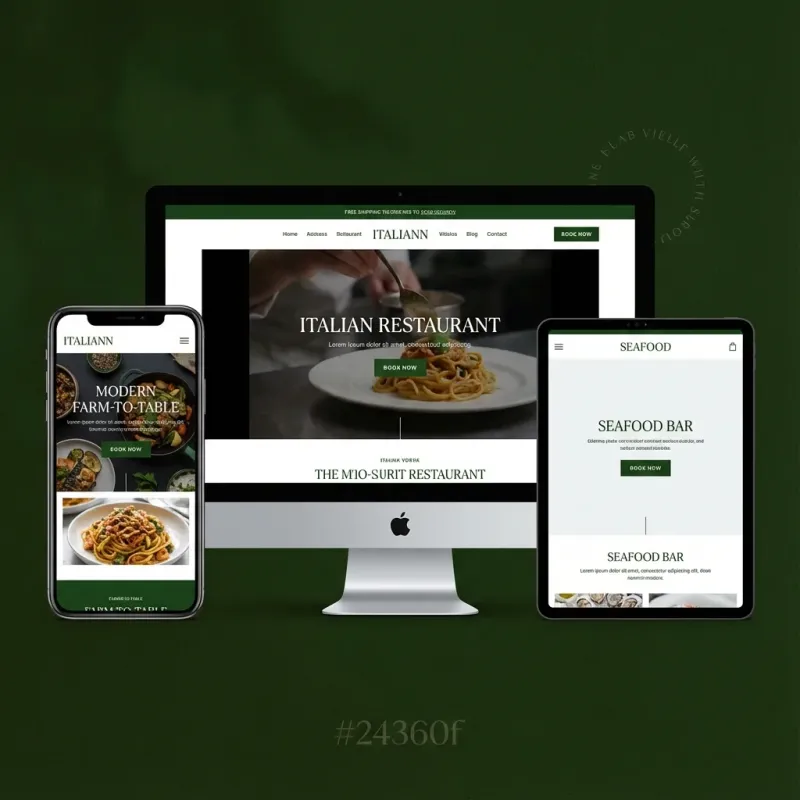
Examples of Perth restaurant websites that demonstrate best practices: fast loading, mobile-responsive design, prominent booking CTAs, and professional photography.
5 Bad Examples: Common Mistakes Perth Restaurants Should Avoid
These examples represent common patterns we see when auditing Perth restaurant websites. We’ve anonymised specific venues but the issues are entirely real—and entirely fixable.
1. A CBD Steakhouse (Anonymous)
Location: Perth CBD
Problem Summary: Catastrophic page speed and PDF menu dependency
What goes wrong: The site takes over eight seconds to load on mobile because of unoptimised hero images (one was 4.2MB). The Largest Contentful Paint metric is 12.4 seconds—more than four times Google’s recommended threshold. The menu is a multi-page PDF that requires downloading (3.1MB), and the “Book Now” button is buried at the bottom of a long, scroll-heavy page. On mobile, body text renders at 12px—too small to read without zooming.
The result: despite excellent food and reviews, the venue’s website has a bounce rate over 70% and captures only a fraction of the bookings it should.
Key lesson: Slow speed and PDF menus are a recipe for high bounce rates. Hungry customers making dinner decisions won’t wait—they’ll click to a competitor. For a deep dive on this issue, see our article on why PDF menus hurt your SEO and conversions.
2. A Family‑Run Italian Restaurant in Leederville
Location: Oxford Street, Leederville
Problem Summary: Bloated WordPress theme and amateur photography
What goes wrong: The website uses a generic WordPress theme with 23 active plugins, causing severe layout shifts as elements load (Cumulative Layout Shift score of 0.42—nearly four times the acceptable threshold). The photo gallery consists of blurry, poorly lit smartphone shots that actually make the food look unappetising despite the venue having excellent reviews on Google.
There’s no clear call‑to‑action for bookings—just a phone number in 11px grey font in the footer. The site lacks any schema markup, meaning it doesn’t appear in rich search results. Mobile users frequently report the navigation menu breaking on certain devices.
Key lesson: Bloated themes and low‑quality visuals undermine credibility and actively harm conversion rates. This venue could see a 25-35% increase in bookings simply by investing in a custom, lightweight design and professional photography. Learn more about the ROI of professional food photography for Perth restaurants.
3. A Pub in Victoria Park
Location: Albany Highway, Victoria Park
Problem Summary: Non-responsive design and inaccessible content
What goes wrong: The site is not responsive—on mobile, the navigation menu collapses into an unusable jumble of overlapping text, and the booking form fields are misaligned so users can’t tap into them correctly. The venue’s address and hours are listed only within a decorative image, making them invisible to Google’s indexing and completely inaccessible to screen readers used by visually impaired customers.
The site was clearly designed for desktop only and hasn’t been updated since 2019. On a 375px mobile viewport (iPhone size), the content overflows horizontally, requiring side-scrolling to view full text.
Key lesson: Ignoring mobile responsiveness and accessibility isn’t just a technical oversight; it’s a barrier that excludes a huge portion of potential customers—including the 65+ age demographic that represents significant dining spend in established suburbs like Victoria Park. For mobile-first best practices, see our website speed optimization guide.
4. A Food Truck in Perth CBD
Location: Various CBD locations
Problem Summary: Complete absence of local SEO fundamentals
What goes wrong: The website lacks every local SEO fundamental: no Google Business Profile link, inconsistent NAP details across pages (three different phone number formats, two different addresses), and no mention of “Perth” or “CBD” in headings, meta descriptions, or page content. The meta title is simply the business name with no location qualifier.
As a result, the truck almost never appears in “food truck near me” or “lunch CBD Perth” searches, despite operating in high-traffic areas. Competitors with basic SEO implementation capture the search traffic that should be theirs.
Key lesson: Even the most creative, popular food business can be invisible online if local SEO fundamentals are missing. Consistent location signals—structured data, Google Business Profile, suburb keywords—are essential for capturing walk-by and search traffic. This is especially critical for mobile businesses where potential customers are actively searching nearby.
5. A Fine‑Dining Restaurant in Claremont
Location: Bay View Terrace, Claremont
Problem Summary: Over-engineered design and outdated technology
What goes wrong: The site relies on auto‑playing background music (immediate turn-off for most users), a complex animated intro sequence that adds 15 seconds to the perceived load time, and a Flash-based interactive menu experience that simply doesn’t work on iOS devices or any modern browser without plugins.
There’s no obvious way to make a reservation without calling—no online booking widget, no email link, just a phone number that appears after the animation sequence completes. For a venue with $80+ average covers targeting a sophisticated Claremont clientele, the website experience is completely misaligned with customer expectations.
Key lesson: Over‑engineering and outdated technologies (Flash, heavy animations, auto-playing audio) create exclusionary experiences and damage both performance and brand perception. The fine-dining audience, in particular, expects sophistication expressed through restraint and usability—not technical complications. Simplicity and accessibility should always come first.

Common website problems we see when auditing Perth restaurant sites: slow loading times, broken mobile layouts, PDF menus, and buried booking functionality.
How to Turn a Bad Website into a Good One: Action Checklist
If you recognise any of the “bad” traits in your own site, don’t panic—each flaw has a straightforward fix. Here’s a prioritised action list for Perth restaurant owners:
Quick Wins (Implement This Week)
- Compress all images: Use tools like TinyPNG or ShortPixel to reduce image file sizes by 60-80% without visible quality loss. Target under 200KB per image.
- Add a booking button to your header: Make “Book a Table” visible within 2 seconds of page load on every page.
- Verify your Google Business Profile: Ensure NAP details match your website exactly—same phone format, same address format, same suburb spelling.
- Check mobile responsiveness: Test your site on BrowserStack or simply use Chrome DevTools to view at 375px width. Fix any horizontal scrolling or broken elements.
Medium-Term Improvements (Next 30 Days)
- Convert PDF menus to HTML: This single change improves both user experience and SEO. Include dietary icons, pricing, and descriptions in searchable text. For a complete guide, see our PDF vs digital menu article.
- Switch to faster hosting: If you’re on cheap shared hosting, migrate to a performance-focused provider or use a CDN like Cloudflare. Aim for Time to First Byte under 400ms.
- Add structured data markup: Implement LocalBusiness and Restaurant schema to enable rich search results with ratings, hours, and cuisine type.
- Integrate a booking widget: Install ResDiary, OpenTable, or a similar system with embedded functionality—not just a link to an external site.
Strategic Investments (Next 90 Days)
- Schedule professional photography: A half-day shoot focused on your signature dishes and venue atmosphere will transform how customers perceive your restaurant online. The ROI typically pays back within 6 months through increased bookings.
- Consider a complete rebuild: If your site is WordPress with legacy theme debt, a rebuild on a modern static framework (like Astro) can improve performance scores from the 30s to the 90s. See our speed optimization guide for technical details.
- Implement local content strategy: Create suburb-specific landing pages and blog content targeting long-tail searches like “romantic restaurant [suburb] Perth” or “group dining [suburb].”
The common thread across all the good examples is that they treat their website as a critical business asset—not just an online brochure. They invest in performance, visuals, and usability because they know that’s what today’s Perth diners expect when researching where to eat.
Perth Restaurant Website Benchmarks: How Does Yours Compare?
Based on our analysis of 50+ Perth hospitality websites, here are the benchmarks you should aim for:
| Metric | Poor | Average | Good | Excellent |
|---|---|---|---|---|
| Google Lighthouse Performance | <50 | 50-70 | 71-89 | 90+ |
| Largest Contentful Paint | >4s | 2.5-4s | 1.8-2.5s | <1.8s |
| Mobile Bounce Rate | >65% | 50-65% | 35-50% | <35% |
| Time to Booking Click | >10s | 5-10s | 2-5s | <2s |
| Mobile Usability Score | <70 | 70-85 | 86-95 | 96+ |
Run your own site through Google PageSpeed Insights and Mobile-Friendly Test to see where you stand.
Ready to Elevate Your Perth Restaurant’s Website?
At Amplify Creative Lab, we specialise in building fast, beautiful, conversion‑driven websites for Perth hospitality venues—from Fremantle waterfront restaurants to Northbridge bars to suburban cafés in Subiaco and Mount Lawley. Because we’re both web developers and professional photographers, we handle everything from the code to the visuals—ensuring your site not only looks stunning but also loads quickly, ranks well for local searches, and turns website visitors into booked tables.
Our Perth restaurant clients typically see:
- Performance scores improving from 30-40 to 90+ after a rebuild
- 20-35% reduction in bounce rates within the first month
- Significant improvement in “near me” and suburb-specific search rankings
- Measurable increases in online booking conversions
Want to see how your current website stacks up? Book a free website audit and we’ll give you a detailed report on its speed, mobile‑friendliness, SEO, and design—plus a clear, prioritised roadmap to make it one of the “good” examples.
Or, if you’re ready for a complete overhaul, explore our Perth restaurant web design services to see how we combine cutting‑edge development with mouth‑watering photography to create websites that work as hard as you do.
Frequently Asked Questions: Restaurant Website Design in Perth
Related reading: For more insights on Perth hospitality website strategy, explore our guides on website speed optimization for Perth venues, why PDF menus hurt your SEO, and how to fix slow hospitality sites without rebuilding everything.