Rollout Context
Why the Dolce&Gabbana Beauty at Myer Perth project matters beyond launch
When a luxury brand completes a new retail fitout, there is a short window where the space is perfect. The joinery is unmarked, the shelves are styled exactly to plan, the glass is spotless and nothing has been moved by a day of trading. Photographing a store opening is largely about capturing that moment properly, because it does not come back.
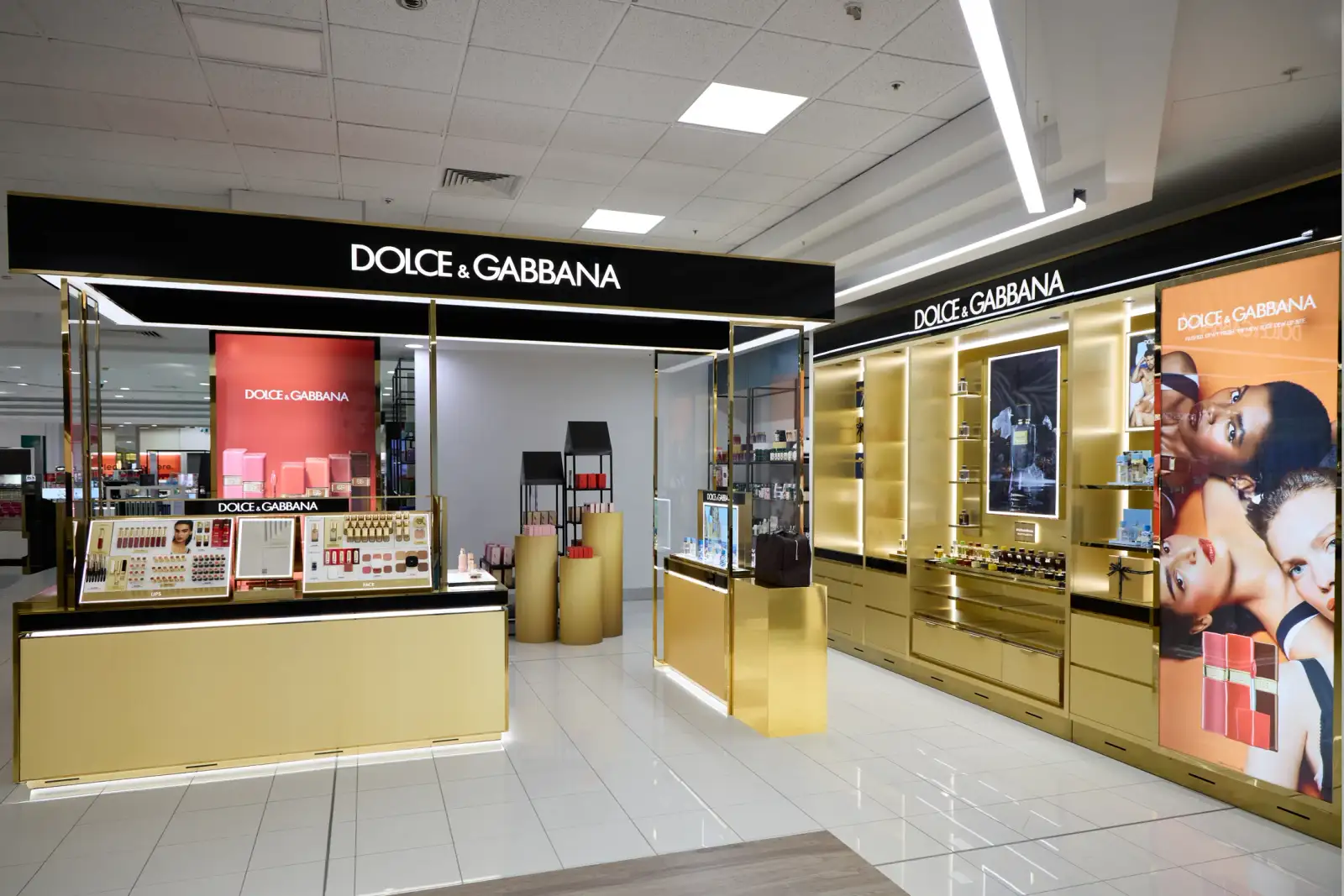
This was the Dolce&Gabbana Beauty concession inside Myer Perth on Murray Street, in the Forrest Chase precinct — the flagship Myer store in the Perth CBD. The brief was to document the finished concession to the standard both a global luxury brand and a major Australian department store expect.
Why gold fitouts are hard to photograph
The Dolce&Gabbana beauty fitout is built almost entirely from surfaces that reflect: brushed and polished gold metal, mirrored columns, backlit glass shelving, black gloss fascias, and a high-gloss white tiled floor running underneath all of it.
That combination creates the same underlying problem we deal with on reflective products, scaled up to an entire room. Every one of those surfaces is showing you something — and by default what it shows is the photographer, the tripod, the lights and whichever part of the shop floor happens to be behind the camera. In a room where nearly every plane is reflective, there is nowhere neutral to stand.
Gold adds a second difficulty on top of the first. It is one of the least forgiving finishes to reproduce accurately. Push the white balance slightly warm and an elegant champagne gold turns brassy and cheap; correct too far the other way and it goes grey and lifeless. Since the entire brand identity of this fitout rests on that gold reading as luxurious, getting the tone right is not a technical nicety — it is the whole job.
The lighting environment made that harder. A department store beauty hall runs on mixed light: warm accent lighting inside the concession’s own joinery, cooler general lighting from the store ceiling, and daylight bleeding in from elsewhere on the floor. Those sources have different colour temperatures, and they all land on the same gold surfaces at once.
Working to brand standard
Brands at this level have exacting visual standards, and a store photography set gets reviewed against them.
Verticals must be true. In an interior built from tall gold columns and rectilinear joinery, any lens distortion or slight camera tilt is instantly visible — lines converge and the joinery looks like it was installed badly. Camera positions and heights were set so that the architecture reads straight.
Reflections must be clean. Angles were worked out per frame so what the gold and mirrored panels reflect is the store itself, not the camera position. This is why the shoot moves methodically rather than quickly: each position is solved before it is shot.
No competitor branding in frame. A concession sits in a hall surrounded by other luxury houses, and a frame that catches a neighbour’s signage is unusable for brand marketing. Compositions were framed to keep the space clean, with the sole exception of the wider context views where the surrounding hall is deliberately part of the story.
Colour must be accurate and consistent. The gold has to be the same gold in every frame, campaign artwork has to keep the tone it was printed to, and product colour — a full row of Velvet Collection bottles, a wall of lip shades — has to be true. The set was graded as one body of work, not frame by frame.
Coverage that works from wide to tight
The gallery was built systematically, because a completed fitout needs documenting at several levels of detail.
Establishing views show the whole concession and how it sits on the floor: the signage, the frontage, the relationship between the open counter area and the fragrance wall behind it. These are the frames that communicate scale and position.
Back wall coverage documents each merchandised section in turn — the Velvet Collection fragrance wall, the campaign panels, the gifting and lip displays. Photographed straight on and evenly lit, these read as a proper record of how the wall was set at handover.
Individual display units were shot in isolation: the freestanding lip plinth, the fragrance counters, the DG monogram pillar. Isolating each fixture makes the set genuinely useful as merchandising reference, since a specific unit can be pulled without cropping it out of a wider scene.
Detail frames cover the styling — how bottles are arranged on a glass shelf, how testers are laid out, how gift boxes are stacked. This is the level that visual merchandising teams actually work from when replicating a standard.
Supporting premium brands in Perth
Working with a luxury house inside a major department store means fitting into two sets of expectations at once, and the practical requirements are real: work efficiently, stay out of the way of staff preparing to trade, and deliver a set that passes brand review without rounds of corrections.
That is the standard we shoot retail to. Whether it is a global fashion house’s beauty concession, a national retailer’s new store, or an independent brand opening its first location in Perth, the process is the same — plan the coverage, solve the reflections, hold the colour, and give the client a set they can use immediately.
The finished gallery gives everyone involved a proper record of the Dolce&Gabbana Beauty concession at Myer Perth as it was intended to look: the gold true, the lines straight, the merchandising exactly as set, and not a light stand in sight.
Opening a new store or completing a fitout in Perth? See our Commercial Photography Perth service or explore more retail and event photography work.