

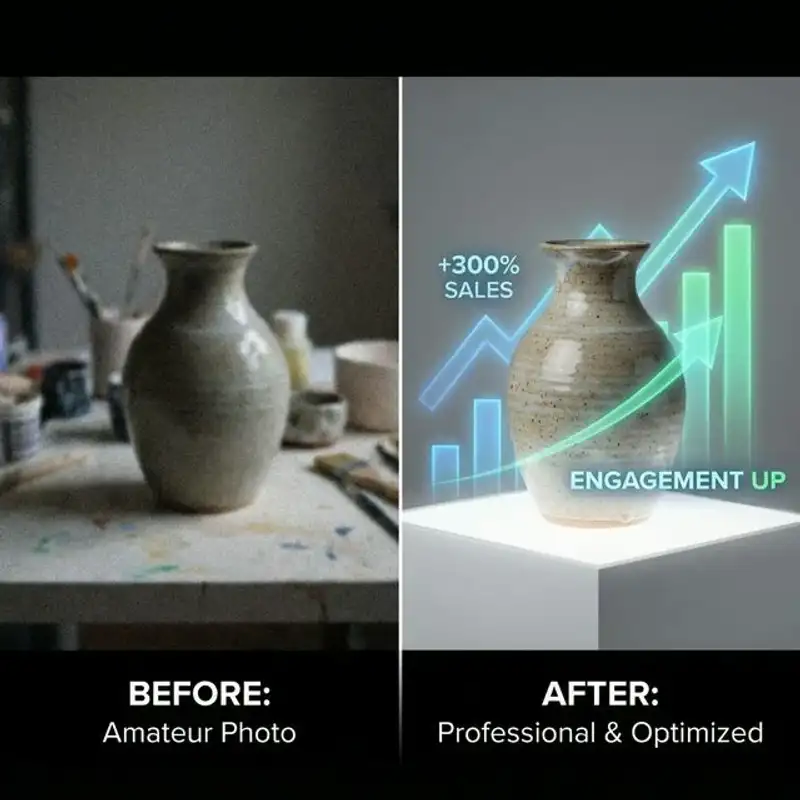
Your Customers Buy With Their Eyes
In a physical store, customers pick products up. They feel the weight of a candle, smell the coffee, hold the dress against their body. Online, all of that disappears. The only thing standing between a browser and a buyer is your imagery.
This isn’t opinion — it’s measurable. E-commerce stores with professional product photography consistently outperform those without, across every metric that matters: conversion rate, average order value, return rate, ad performance, and customer trust.
Yet it’s the most under-invested area we see when auditing Perth online stores. Businesses spend thousands on ecommerce store design strategy and build decisions, then upload dimly lit iPhone photos that undermine every pixel of that investment.
The Numbers: What Visual Assets Actually Do to Conversions
Conversion Rate
Products with professional photography see 2–3× higher conversion rates compared to amateur imagery. The gap is even wider for products over $50, where purchase anxiety is higher and customers scrutinise images more carefully before committing.
Think about your own behaviour online. When you see a product with one blurry image versus one with six crisp, well-lit shots from multiple angles — which do you trust more? Which do you buy from?
Return Rates
Returns are the silent profit killer in e-commerce. They cost you shipping, restocking time, and occasionally damaged goods. Professional photography that accurately represents colour, texture, size, and materials reduces returns by up to 22%.
The reason is simple: customers receive exactly what they expected. No surprises about colour (that “navy” that looked teal on screen), no disappointment about size (it looked bigger in the photo), no frustration about quality (the texture looked premium but felt cheap).
Average Order Value
High-quality imagery communicates product quality. When your products look premium, customers perceive them as premium — and they’re willing to pay accordingly. Stores that upgrade to professional photography typically see 10–25% higher average order values without changing prices.
Lifestyle photography drives this further. Showing a product styled beautifully in a real setting triggers aspiration: “I want my home/wardrobe/kitchen to look like that.” Cross-selling through lifestyle images (showing complementary products together) increases basket size naturally.
Ad Performance
Whether you’re running Google Shopping, Instagram ads, or Facebook catalogue campaigns, the creative is the single biggest variable in performance. Professional product photos deliver:
- 30–50% higher click-through rates on Google Shopping
- Lower cost-per-click because platforms reward high-engagement ads
- Better ROAS (return on ad spend) because clicks convert at higher rates
- Fewer ad disapprovals — Google and Meta have strict image quality requirements
The Five Types of Visual Assets Every E-commerce Store Needs
1. White-Background Packshots
The foundation of your product catalogue. Clean, consistent, well-lit images on pure white backgrounds. These are what customers see in search results, category pages, and comparison shopping. They’re also required for Google Shopping and most marketplaces.
What makes a great packshot: Consistent lighting across all products, true-to-life colours, sharp focus on key details, multiple angles (front, back, side, top), and enough resolution for zoom functionality (minimum 1500×1500 pixels).
Learn more about packshot photography: Packshot vs Lifestyle Product Photography: What to Use and When
2. Lifestyle Photography
Lifestyle images show your product in context — being used, worn, styled, or enjoyed in a real-world setting. While packshots answer “what does this look like?”, lifestyle photography answers “what would my life look like with this?”
For Perth businesses, lifestyle imagery that reflects local settings creates an authentic connection. A skincare product photographed against Cottesloe Beach at golden hour. Homewares styled in a light-filled Fremantle apartment. Artisan food laid out on a jarrah table. These images sell a feeling, not just a product.
3. Detail and Texture Shots
Close-up images that reveal what the eye can’t see at normal distance: the grain of leather, the weave of fabric, the finish on ceramics, the ingredients in a food product. Detail shots bridge the tactile gap of online shopping — they let customers “feel” the product through their screen.
These images also pre-empt customer questions and reduce support enquiries. If someone can see the stitching quality, material thickness, or ingredient label in a close-up, they don’t need to email asking about it.
4. Scale and Context Images
One of the most common reasons for e-commerce returns: “It was bigger/smaller than I expected.” Scale images solve this by showing the product next to a familiar reference point — a hand holding the product, the item on a table, or a model wearing the clothing.
Include dimensions in your product descriptions, but understand that numbers don’t register the same way images do. A candle that’s “8cm × 12cm” is abstract; a candle photographed next to a coffee cup is immediately understood.
5. Video Content
Product pages with video see 73% higher purchase likelihood. Short-form video (15–30 seconds) is increasingly expected, not just appreciated. Show the product being unboxed, used, or demonstrated. Show how fabric drapes and moves. Show food being prepared or served.
For Perth e-commerce stores, video also powers social media content. The same 30-second product clip works on your product page, Instagram Reels, TikTok, and Facebook ads. One shoot, multiple assets, multiple channels.
Visual Consistency: The Brand Trust Multiplier
Individual great photos aren’t enough. What separates amateur stores from professional ones is visual consistency — the feeling that every image belongs to the same brand.
Consistency means:
- Same lighting style across all products (not some natural light, some flash, some overhead)
- Same background treatment (not some white, some grey, some on random surfaces)
- Same colour grading — a cohesive editing style that matches your brand
- Same composition rules — consistent framing, spacing, and product positioning
- Same image dimensions — uniform aspect ratios so your category grid looks clean
Inconsistent imagery signals “I threw this together.” Consistent imagery signals “this brand pays attention to detail.” Customers transfer that perception to your products.
Technical Optimisation: Making Images Work for Speed and SEO
Beautiful images that slow your site down hurt more than they help. The best e-commerce sites balance visual quality with technical performance:
Image Format
Use WebP as your primary format with JPEG fallback. WebP delivers 25–35% smaller file sizes than JPEG at equivalent quality. Modern browsers (99%+ of Australian users) support it natively.
Responsive Images
Serve different image sizes for different devices. A 2000px product image designed for desktop zoom shouldn’t load on a mobile phone. Use srcset and sizes attributes to let the browser choose the appropriate resolution.
Lazy Loading
Only load images as customers scroll to them. This dramatically improves initial page load speed — especially on category pages with dozens of product thumbnails. Native browser lazy loading (loading=“lazy”) works for most use cases.
Compression
Target under 200KB per image without visible quality loss. Tools like Sharp, Squoosh, or your CMS’s built-in optimisation can compress images aggressively while maintaining the visual quality that drives conversions.
Alt Text and SEO
Every product image needs descriptive alt text. Not just for accessibility (though that matters enormously), but for SEO. Google Images is a significant traffic source for e-commerce. “Handmade soy candle in amber glass jar – Australian eucalyptus scent” beats “IMG_4523” in every way.
The ROI Calculation: Is Professional Photography Worth It?
Let’s run real numbers for a Perth e-commerce store:
- Current conversion rate with amateur photos: 1.5%
- Monthly visitors: 2,000
- Average order value: $75
- Monthly revenue: 2,000 × 1.5% × $75 = $2,250
After investing in professional product photography:
- New conversion rate: 3% (conservative 2× improvement)
- New average order value: $85 (13% increase from better imagery)
- New monthly revenue: 2,000 × 3% × $85 = $5,100
- Monthly revenue increase: $2,850
If the photography session cost $1,500, it pays for itself in 16 days. And those images keep working for you — across your website, ads, social media, and email campaigns — for 12+ months before they need refreshing.
Compare that to other marketing investments: a $1,500 Google Ads campaign might generate traffic for a month. $1,500 in photography generates higher conversions from all your traffic, permanently.
Common Visual Asset Mistakes We See in Perth E-commerce Stores
Inconsistent Backgrounds
Some products on white, some on marble, some on a kitchen bench. It makes your store look unprofessional and makes products impossible to compare visually. Pick a consistent style and stick to it.
Only One Image Per Product
A single image asks customers to make a buying decision with minimal information. Multiple angles, detail shots, and lifestyle images reduce uncertainty and boost confidence. Aim for 4–6 images minimum per product.
Oversized, Uncompressed Files
Uploading 5MB photos straight from the camera tanks your page speed. Every additional second of load time costs you conversions. Optimise before uploading — your images should be under 200KB each without visible quality loss.
Missing Scale References
Customers can’t gauge size from a product-on-white image alone. Include at least one image showing the product in hand, on a body, or next to a familiar object. This single addition measurably reduces size-related returns.
Stale Imagery
Using the same photos for years signals a stagnant brand. Refresh your hero images and lifestyle shots annually. Update immediately when packaging changes. Seasonal refreshes (summer styling vs winter styling) keep your store feeling current.
Building Your Visual Asset Library
The smartest approach isn’t a one-off photo shoot — it’s building a visual asset library that serves every channel:
- White-background packshots → Product pages, Google Shopping, marketplaces
- Lifestyle images → Homepage, social media, blog posts, email campaigns
- Detail shots → Product pages, zoom gallery
- Behind-the-scenes → Social media, About page, brand storytelling
- Short-form video → Product pages, Reels, TikTok, ads
A single well-planned product photography session can generate assets for 3–6 months of content across all channels. That’s efficient marketing spend.
Start With Photography, Then Build the Store Around It
Here’s a counterintuitive recommendation we give Perth businesses launching e-commerce: invest in product photography before you finalise your website design.
Why? Because your best images should inform your design decisions — hero banner sizing, product grid layouts, colour palette, and overall visual direction. A website designed around stunning photography looks cohesive. A website with photography shoehorned into a pre-built template looks compromised.
Whether you’re building on Shopify or a custom Next.js frontend, the visual assets are what customers remember. The platform is invisible when the imagery is exceptional.
Ready to build a visual asset library that drives conversions? Get in touch — we handle both the photography and the website to ensure everything works together.
Related: Ecommerce Photography Perth: Getting Your Products Online-Ready | How Much Does Product Photography Cost in Perth? [2026 Guide]
For the brand and campaign layer around those images, explore our graphic design services, brand identity work, and digital design support.