

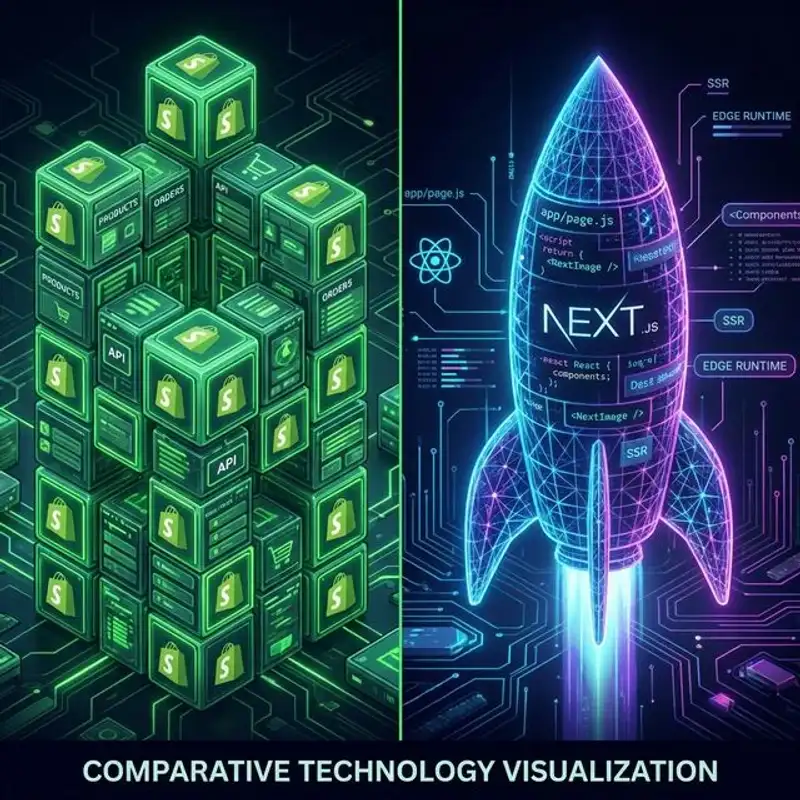
The Platform Decision That Shapes Your Business
Every Perth business launching an online store faces the same question: do I go with Shopify, or build something custom? The answer isn’t as simple as “Shopify is easier” or “custom is better.” It depends on where your business is today, where it’s heading, and what trade-offs you’re willing to make.
We’ve built both for Perth clients — Shopify stores for artisan food producers in Fremantle, and custom headless builds for design-led brands competing nationally. Here’s an honest breakdown of each approach, with real numbers.
Shopify: The Case For
Everything in One Box
Shopify handles hosting, security, SSL certificates, PCI compliance, payment processing, inventory management, shipping labels, and tax calculation. For a business owner who wants to focus on products rather than technology, this is enormously valuable.
You sign up, pick a theme, add your products, connect Shopify Payments (with Australian processing rates of 1.75% + $0.30), and you’re live. The Shopify admin dashboard is intuitive enough that most business owners manage day-to-day operations without a developer.
The App Ecosystem
Need email marketing? There’s Klaviyo. Reviews? Judge.me. Subscriptions? Recharge. Loyalty programs? Smile.io. Shopify’s app store has thousands of plug-and-play solutions for almost any feature you can imagine.
The hidden cost: Apps add up. A typical Perth store running reviews, email marketing, upsells, and loyalty might spend $100–$300/month on apps alone — on top of the $39–$399/month Shopify plan. This becomes a factor at scale.
Speed to Market
A Shopify store can launch in 2–4 weeks with professional setup. Choose a premium theme ($250–$400 one-time), customise colours, fonts, and layout, upload products with professional photography, configure shipping zones for WA and interstate, and you’re selling.
Where Shopify Falls Short
- Performance: Shopify themes load a significant amount of JavaScript. Average Shopify store page speed scores sit at 30–50 on Google PageSpeed Insights. That’s functional, but not fast.
- Design limitations: Even with Shopify’s theme editor, you’re working within constraints. Every Shopify store has a recognisable “Shopify look” — fine for most businesses, limiting for premium brands.
- Liquid templating: Shopify’s Liquid language is less flexible than modern JavaScript frameworks. Complex layouts, animations, and interactive features require workarounds.
- Vendor lock-in: Your store lives on Shopify’s infrastructure. If they raise prices (which they have, repeatedly), you pay or migrate. Your theme code isn’t easily portable.
Custom Next.js: The Case For
Raw Performance
This is where custom builds shine brightest. A Next.js frontend with static site generation (SSG), incremental static regeneration (ISR), and edge caching delivers page loads under 1 second. Product pages that would take 3–4 seconds on Shopify load in 500ms.
For e-commerce, speed is revenue. Research consistently shows that every 100ms improvement in load time increases conversion by 1%. A custom Next.js store that loads in 800ms versus a Shopify store at 3.5 seconds isn’t just faster — it’s measurably more profitable.
Total Design Freedom
No theme constraints. No Liquid workarounds. You design exactly what your brand needs — unique product page layouts, immersive storytelling sections, custom filtering experiences, interactive product configurators, and transitions that feel premium.
For Perth brands selling nationally — competing against Sydney and Melbourne businesses with bigger budgets — a distinctive online experience is a genuine competitive advantage. Your website stops looking like “another Shopify store” and starts feeling like a destination.
The Headless Architecture
The most common custom approach uses headless Shopify: Shopify handles the commerce backend (products, inventory, payments, orders) via its Storefront API, while Next.js renders the customer-facing frontend.
This means you keep everything you love about Shopify’s admin — the product management, order processing, shipping integration — while delivering a frontend experience that’s faster and more flexible than any Shopify theme.
Other backend options include:
- Medusa.js: Open-source, self-hosted, no transaction fees
- Saleor: GraphQL-first, great for complex catalogues
- Commerce.js: API-first, lightweight for smaller stores
Where Custom Falls Short
- Upfront cost: $8,000–$15,000+ versus $1,500–$3,000 for Shopify. The gap is real.
- Development time: 6–12 weeks versus 2–4 weeks. You need patience and planning.
- Ongoing maintenance: You need a developer (or agency) for updates, new features, and bug fixes. Shopify handles infrastructure; with custom, you manage hosting and deployments.
- No app store: Features that are one-click installs on Shopify need to be built or integrated manually. Reviews, loyalty programs, and email marketing require custom integration.
Head-to-Head Comparison
Setup Cost
Shopify: $1,500–$3,000 (theme + customisation + product setup)
Custom Next.js: $8,000–$15,000+ (design + development + integrations)
Monthly Cost
Shopify: $39–$399/month + $100–$300/month in apps
Custom Next.js: $20–$50/month hosting (Vercel/Netlify) + Shopify Lite ($9/month for backend) or headless CMS costs
Page Speed (Google PageSpeed Score)
Shopify: 30–50 (typical theme store)
Custom Next.js: 90–100 (with proper optimisation)
Time to Launch
Shopify: 2–4 weeks
Custom Next.js: 6–12 weeks
Design Flexibility
Shopify: Limited to theme structure, customisable within constraints
Custom Next.js: Unlimited — pixel-perfect implementation of any design
SEO Control
Shopify: Good basics (meta tags, sitemaps, redirects) but limited URL structure and schema control
Custom Next.js: Full control over every SEO element — URLs, schema markup, meta tags, internal linking architecture
The Decision Framework for Perth Businesses
Choose Shopify If:
- You’re launching your first online store and need to validate demand
- Your budget is under $5,000 for the initial build
- You want to manage the store yourself without ongoing developer support
- You sell fewer than 200 products with straightforward categories
- You need to launch within a month
- You’re a Perth retailer testing e-commerce alongside your physical store
Choose Custom Next.js If:
- Brand presentation and design differentiation are critical to your positioning
- You’re competing nationally and need every performance advantage
- Your Shopify app costs are approaching or exceeding $200/month
- You need custom functionality (product configurators, complex filtering, interactive lookbooks)
- Page speed and SEO are competitive differentiators in your market
- You have the budget ($8,000+) and patience (6–12 weeks) for a proper build
The Smart Middle Ground: Start Shopify, Go Headless
Many of our Perth clients take a phased approach. Launch on Shopify to start generating revenue and learn what your customers actually want. Once you’re doing $10,000+/month and understand your audience, invest in a custom headless frontend.
The beauty of headless architecture: your Shopify backend stays exactly the same. Products, inventory, orders — nothing changes. You’re only upgrading the customer experience. It’s a renovation, not a demolition.
What Both Approaches Have in Common
Regardless of your platform choice, two things determine your e-commerce success more than technology:
1. Professional Product Photography
A $15,000 custom website with iPhone photos will underperform a $2,000 Shopify store with professional product imagery. Product photography is the single highest-ROI investment in e-commerce. Every platform, every design — they all need great images to convert.
Your product photos need to work across your website, Google Shopping ads, Instagram, Facebook Marketplace, and email campaigns. Invest in a library of versatile images: white-background packshots, lifestyle shots, detail close-ups, and scale references.
Read more: Why Visual Assets Are the Secret Weapon of High-Converting E-commerce Stores
2. Customer Experience Beyond the Homepage
Fast checkout, clear shipping information, easy returns, responsive customer service — these matter more than whether you’re running Shopify or Next.js. The platform is the foundation; the experience you build on it is what converts.
Our Recommendation for Perth Businesses
We build both. We recommend Shopify for businesses testing the waters and custom headless builds for brands ready to invest in long-term competitive advantage. What we always recommend, regardless of platform: start with professional product photography. It’s the one investment that pays off immediately, on any platform, for any business.
Ready to scope the right platform path? Start with our ecommerce development service if the decision now depends on platform fit, catalogue complexity, or backend workflow. If the next step is a richer customer interface or app-style frontend, compare it with our web app development service.
If you are weighing architecture tradeoffs in more detail, compare this overview with our headless vs monolithic ecommerce guide. For the commercial side of the decision, use our Shopify Plus vs custom ecommerce breakdown to pressure-test total ownership cost, B2B requirements, and operational fit before locking the stack.