The Restaurant Marketing Dilemma: Where Should You Spend?
Every Perth restaurant owner faces the same question: Should I spend money on Google Ads and Facebook promotions, or invest in SEO? The answer isn’t as simple as choosing one over the other—it depends on your timeline, budget, and business goals.
We’ve seen Perth restaurants waste thousands on poorly targeted ads that deliver expensive, one-time customers. We’ve also seen venues invest in SEO and wonder why results take months to appear. Both scenarios come from misunderstanding what each strategy actually delivers.
This guide breaks down the real numbers—cost per booking, ROI timelines, and when to use each approach—specifically for Perth hospitality venues. Whether you’re a new opening in Northbridge needing immediate visibility or an established Fremantle restaurant looking to reduce your marketing costs, you’ll know exactly where to invest.
Understanding the Fundamental Difference
Understanding the fundamental difference between SEO and paid advertising is crucial for making an informed decision. SEO is a long-term investment that builds organic visibility over months, while paid ads are a short-term tactic that delivers traffic as long as you keep paying.
Think of it this way: Paid ads are like renting visibility. SEO is like buying it. Rent gives you immediate occupancy, but you’ll pay every month forever. Ownership requires a larger upfront investment, but eventually, you stop paying and keep the asset.
Paid Ads: Instant Visibility, Instant Cost
With platforms like Google Ads, Facebook Ads, and Instagram Promotions, you can place your restaurant in front of hungry customers within hours. This is ideal for:
- Launching a new venue or menu – generate buzz and immediate bookings in the first weeks
- Promoting events – Valentine’s Day dinners, Christmas parties, live music nights, Melbourne Cup lunches
- Targeting specific demographics – tourists in Perth CBD, office workers in Northbridge, families in Subiaco, young professionals in Mount Lawley
- Testing messaging or offers – see what resonates before committing to broader campaigns
- Filling slow periods – midweek lunch specials, quiet winter months
The downside: The moment you stop paying, the traffic stops. Zero residual value. For Perth restaurants with tight margins, this can become a significant ongoing expense that never decreases.
SEO: The Slow Burn That Pays Off for Years
SEO involves optimising your website, content, and online presence to rank higher in organic (non-paid) search results. It includes:
- Technical SEO – fast loading speeds, mobile-friendly design, clean code (see our article on website speed optimization for Perth venues)
- On-page SEO – keyword-rich menu pages, localised content, optimized meta descriptions, proper heading structure
- Local SEO – Google Business Profile optimization, local citations, reviews, map pack visibility
- Content marketing – blog posts about Perth food trends, recipe ideas, venue highlights, neighbourhood guides
- Technical foundations – schema markup, internal linking, proper HTML menus (see why PDF menus hurt your SEO)
While SEO takes 3–6 months to show significant results, those rankings can sustain for years with minimal ongoing cost. A single blog post about “best seafood restaurants Fremantle” can continue attracting bookings for 3-5 years after publication.
Cost Comparison: The Real Numbers
To understand the financial impact, let’s compare typical costs for a Perth restaurant based on real data from venues we’ve worked with:
| Metric | Paid Advertising | SEO |
|---|---|---|
| Upfront Cost | Low to medium ($500–$2,000/month) | Medium to high ($3,000–$8,000 one-off) |
| Ongoing Cost | High (campaigns stop when budget stops) | Low (~$200–$500/month maintenance) |
| Time to First Results | Hours to days | 3–6 months |
| Average Cost per Booking | $15–$50 (varies by competition) | $2–$10 (after initial investment) |
| Cost Trend Over Time | Stays constant or increases | Decreases significantly |
| Long-Term Value | Zero after spending stops | Continues for years |
| Competitor Impact | Bidding wars increase costs | Rankings more stable once achieved |
Key insight: Paid ads have a predictable, recurring cost that can eat into your profit per booking—and that cost often increases as competitors enter the auction. SEO requires a larger upfront investment but delivers a much lower cost per acquisition over time, making it more profitable for established venues planning to stay in business for multiple years.
ROI Over Time: Which Delivers More Bookings?
Let’s look at a hypothetical Perth restaurant investing $5,000 over 12 months—the kind of budget a Northbridge or Fremantle venue might have available for digital marketing.
Scenario A: $5,000 Allocated to Paid Ads
Spending $5,000 on Google Ads at an average cost per click of $3.50 and a 5% conversion rate yields approximately:
| Ad spend | $5,000 |
| Average cost per click | $3.50 |
| Total clicks | 1,428 |
| Conversion rate | 5% |
| Total bookings | ~71 |
| Cost per booking | $70.42 |
After 12 months: The traffic and bookings stop completely unless you inject more funds. You’ve exchanged $5,000 for 71 customers. Next year, you’ll need another $5,000 (or more, as CPCs rise) for the same result.
Scenario B: $5,000 Allocated to SEO
Investing $5,000 in a comprehensive SEO package (technical optimization, local SEO, content creation) typically generates:
| Initial investment | $5,000 |
| Months 1-3 | Foundation building, minimal visible traffic |
| Months 4-6 | Traffic begins growing, rankings improve |
| Months 7-12 | 200-400 organic visits/month |
| Organic conversion rate | 7-10% (higher intent than paid traffic) |
| Year 1 bookings | 80-120 |
| Year 1 cost per booking | $41-$62 |
More importantly—Year 2 and beyond: With minimal ongoing investment ($200-$400/month for maintenance), the same SEO assets continue to deliver:
- 150-300 bookings in Year 2
- Cost per booking drops to under $10
- Compounding returns as domain authority grows
- Content continues ranking for 3-5+ years
The verdict: SEO delivers significantly more bookings over a 2-3 year horizon, while paid ads can provide a quick boost when needed. The key is understanding what you need and when.
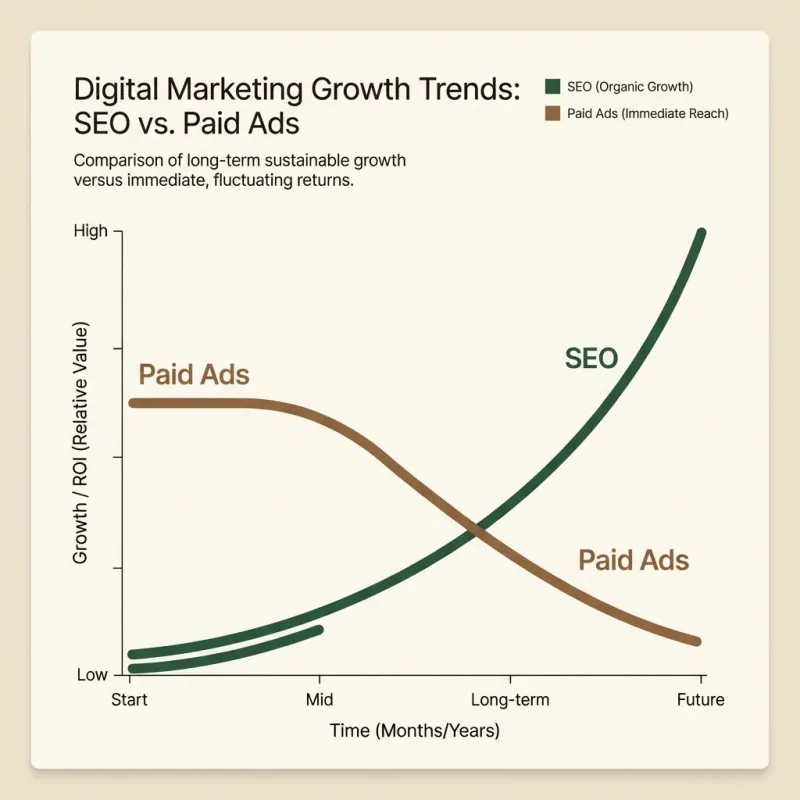
Cumulative bookings over time: SEO requires patience in months 1-6, but delivers significantly more value by month 12 and beyond.
Local SEO: The Perth Advantage
For Perth restaurants, local SEO is especially powerful. When someone searches “restaurant near me,” “café Northbridge,” or “best pizza Perth,” Google prioritizes businesses with strong local signals. And Perth’s dining scene is uniquely neighbourhood-driven.
A restaurant in Fremantle isn’t competing with venues in Joondalup—they’re competing with other Fremantle restaurants. This geographic specificity makes local SEO highly effective and often less competitive than broader paid advertising.
What Is Local SEO?
Local SEO is the practice of optimizing your online presence to attract customers from specific geographic areas. It includes:
- Google Business Profile – complete, verified, with regular posts, photos, and updates. This directly impacts your visibility in the “map pack” (the three business listings shown with a map in search results).
- Local citations – consistent Name, Address, Phone (NAP) across directories like Yelp, TripAdvisor, Yellow Pages, and industry-specific sites.
- Reviews – positive reviews from Perth customers, with keywords naturally included (see how to generate reviews ethically).
- Location-based keywords – naturally incorporating suburb names (Fremantle, Leederville, Mount Lawley, Subiaco, Cottesloe, Victoria Park) into your website content.
- Local content – blog posts about Perth food scenes, neighbourhood guides, local event tie-ins.
The Map Pack Opportunity
When someone searches “Italian restaurant Northbridge,” the first thing they see is the Google Map Pack—three businesses displayed with ratings, hours, and a map. 70% of local searchers click on a Map Pack result.
Ranking in this Map Pack requires:
- Proximity to the searcher (you can’t control this)
- Relevance (proper categorization and keywords)
- Prominence (reviews, citations, website authority)
Because Perth’s hospitality scene is highly neighbourhood-driven, ranking for local searches can fill your tables with customers who are already nearby and ready to dine. This is something generic paid ads often miss unless you use precise geo-targeting—which most restaurants don’t set up correctly.
When to Choose Paid Ads
Despite SEO’s long-term advantages, paid ads are the right choice in specific situations:
Ideal Scenarios for Paid Advertising
| Situation | Why Paid Ads Work | Platform Recommendation |
|---|---|---|
| New venue launch | Need immediate visibility before SEO kicks in | Google Ads + Instagram + Facebook |
| Event promotion | Time-sensitive, specific audience | Facebook/Instagram Events |
| Seasonal push | Christmas, Valentine’s Day, Mother’s Day | Google Ads (search intent) |
| Testing new markets | Quick data on what messaging works | Facebook (audience testing) |
| Filling slow periods | Midweek lunch, quiet winter months | Google Local Ads |
| Retargeting visitors | Capture people who visited but didn’t book | Facebook/Google Remarketing |
Paid Ads Best Practices for Perth Restaurants
- Use tight geographic targeting: Target specific suburbs (5-10km radius), not all of Perth
- Schedule ads around dining decisions: 11am-1pm for lunch, 4pm-7pm for dinner
- Use ad extensions: Location, call, and reservation extensions increase click-through rates
- Include pricing: Ads that mention price ranges attract more qualified clicks
- Rotate creative: Fresh images and copy prevent ad fatigue
When to Choose SEO
SEO is the better investment when you’re building for the long term:
Ideal Scenarios for SEO Investment
- Established venue – You’ve been operating for 6+ months and plan to stay in business for years
- Reducing marketing costs – You want to lower your cost per acquisition over time
- Dominating local search – You want to be the first result when someone searches “[cuisine] [suburb]“
- Building brand authority – You want to be seen as the go-to venue in your category
- Competing with larger budgets – You can’t outspend corporate chains on ads, but you can outrank them organically
SEO Investment Priorities for Perth Restaurants
- Technical foundation: Fast, mobile-friendly website with HTML menus (not PDFs)
- Google Business Profile: Complete optimization with regular posts and photos
- Review generation: Systematic approach to collecting and responding to reviews
- Local content: Suburb-specific landing pages and relevant blog content
- Photography integration: Professional images that improve engagement metrics
Integrating Both for Maximum Impact
The most effective strategy isn’t “SEO or paid ads”—it’s “SEO and paid ads” working together. Here’s how Perth restaurants can combine them:
- Use paid ads to accelerate SEO efforts – Run ads targeting keywords you’re trying to rank for organically. The increased traffic and engagement can send positive signals to Google, potentially boosting your organic rankings faster.
- Retarget website visitors – Install a Facebook pixel and Google Ads remarketing tag to show ads to people who’ve visited your menu page but didn’t book. This recaptures lost conversions at a fraction of new-customer acquisition cost.
- Promote your best-performing organic content – If a blog post about “Perth’s best coffee” is already ranking on page 2, a small ad budget can push it to the top of page 1, establishing authority and capturing traffic.
- Seasonal boosts – Use paid ads during busy periods (Christmas, Valentine’s Day, long weekends) while maintaining SEO for year-round visibility.
- Test messaging with ads, scale with SEO – Use paid ads to test what headlines and offers resonate, then create SEO content around the winners.
This integrated approach ensures you get immediate results while building a sustainable, long-term traffic engine. The advertising supports the SEO, and the SEO eventually reduces your reliance on advertising.
The Foundation: Your Website Matters Most
Here’s what many restaurant owners miss: Neither SEO nor paid ads will perform if your website can’t convert visitors into bookings.
Before investing in either strategy, ensure your website has:
- Fast loading speed: Under 3 seconds on mobile (see our speed optimization guide)
- Mobile-friendly design: 80%+ of restaurant traffic is mobile
- HTML menu (not PDF): Searchable, indexable, easy to browse (see why PDFs hurt your SEO)
- Professional photography: Images that make people want to book (see the ROI of food photography)
- Clear booking path: One-click access to reservations from every page
- Schema markup: Restaurant and menu structured data for rich search results
Think of your website as the conversion engine. SEO and paid ads are traffic sources feeding into that engine. If the engine is broken (slow, confusing, unappealing), more traffic just means more missed opportunities.
Making the Right Choice for Your Perth Restaurant
Your decision should be based on your business goals, timeline, and budget:
| Your Situation | Recommended Approach | Budget Allocation |
|---|---|---|
| New opening, need bookings now | Paid ads primary, start SEO foundation | 70% ads / 30% SEO |
| Established, want to reduce costs | SEO primary, tactical ads for events | 70% SEO / 30% ads |
| Launching new menu or concept | Paid ads for launch, SEO for sustainability | 60% ads / 40% SEO (shift over time) |
| Slow season or underperforming | Paid ads for immediate boost | 100% ads (short term) |
| Healthy cash flow, long-term thinking | Both working together | 50% SEO / 50% ads |
Remember, a well-optimised website is the foundation for both SEO and paid ads. If your site is slow, not mobile-friendly, or uses PDF menus, neither strategy will perform well. Fix the foundation first.
Frequently Asked Questions: SEO vs Paid Ads
Ready to Boost Your Restaurant’s Bookings?
Whether you’re leaning toward SEO, paid ads, or a combination, the key is to start with a website that’s built to convert. At Amplify Creative Lab, we specialize in Perth restaurant web design that combines mobile-first development, professional food photography, and data-driven marketing strategies.
We don’t just build websites—we build booking engines. And we can help you develop a marketing strategy that uses both SEO and paid advertising to maximize your return on every dollar spent.
Not sure which approach is right for you? Book a free digital strategy session and we’ll analyse your current online presence, identify the biggest opportunities for growth, and create a tailored plan to increase your bookings—both today and in the long run.
Related reading: Learn about local SEO mistakes Perth venues make, see how to generate more reviews ethically, and explore what makes a good vs bad restaurant website.