

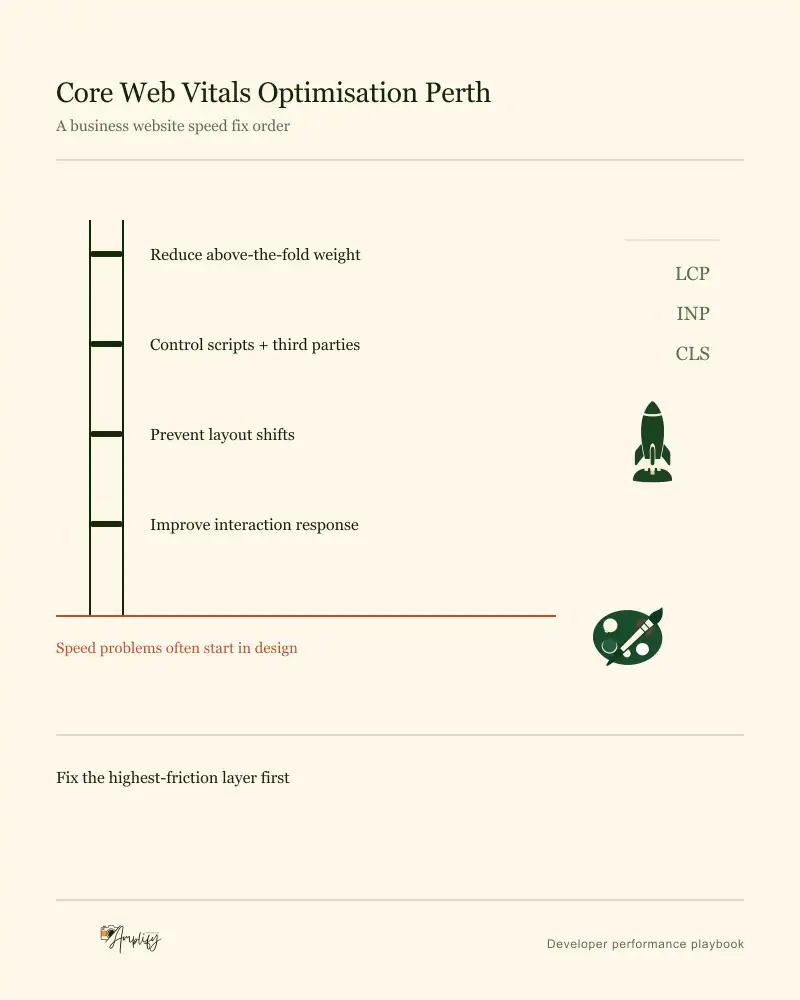
A practical way to think about Core Web Vitals
Many businesses treat Core Web Vitals like a score-chasing exercise. That usually creates busywork.
The better approach is to ask three customer-focused questions:
- What is slowing the first meaningful paint?
- What is making interaction feel sluggish?
- What is causing the layout to move under the user?
Those questions map directly to LCP, INP, and CLS, but the real goal is simpler: help visitors see the page, trust it, and act without frustration.
The metrics and what usually breaks them
| Metric | What it measures | Common cause |
|---|---|---|
| LCP | How fast the main content appears | Heavy hero media, poor caching, slow server response |
| INP | How quickly the page reacts | Too much JavaScript, expensive handlers, script contention |
| CLS | How stable the layout stays | Images without reserved dimensions, injected UI, font shift |
Fix order that works in the real world
1. Reduce above-the-fold weight
Start with the hero. If the first screen is heavy, every other optimisation has less effect.
<img
  src="/images/hero.webp"
  width="1440"
  height="900"
  loading="eager"
  decoding="async"
  alt="Project hero"
/>
Reserve dimensions, keep the file lean, and avoid multiple competing hero assets.
2. Cut non-critical script work
Many slow sites are not image problems alone. They are script problems.
requestIdleCallback(() => {
  import("./non-critical-widget.js");
});
If the script does not help the user complete the first task, it should not compete for the first render.
3. Remove layout instability
CLS problems are often created in design and CMS workflow, not only code. Reserve space for images, embeds, banners, and late-loading widgets.
4. Audit interaction hotspots
INP is usually worst on menus, sticky headers, forms, search, or over-animated sections. Test the components people actually touch on mobile, not just the homepage in lab conditions.
Before-and-after benchmark format
Use a simple benchmark table so performance work stays commercial:
| Metric | Before | After |
|---|---|---|
| LCP | 4.3s | 2.1s |
| INP | 310ms | 145ms |
| CLS | 0.23 | 0.04 |
| Mobile bounce rate | 63% | 44% |
That kind of reporting is far more useful than saying the score “feels better.”
When patching stops being efficient
If the site is slow because the whole architecture is heavy, one more optimisation sprint may not solve the real problem. In that case, the cleaner move is usually to scope the rebuild through our web development Perth service before choosing the exact technical stack.
If the problem is ongoing technical hygiene after launch, pair that work with our website maintenance Perth support and compare it with our website security checklist for Perth SMEs. If slow interactions come from dashboards, portals, or logged-in workflows, then web app development Perth may be the better specialist path.
Final take
Core Web Vitals improve fastest when you fix the experience first and the metrics second.
That means lighter hero media, less client-side work, more stable layout, and cleaner architecture where necessary.
If your current site is carrying too much technical debt, start with our web development Perth service, then review website maintenance Perth if the main need is ongoing checking after the fix.
Tap through our website brief builder and we'll recommend the right next step.