

Core Web Vitals are the practical speed and stability metrics Google uses to judge real user experience. For Perth restaurants, cafes, bars, and hospitality venues, they affect more than rankings. They influence whether a customer stays long enough to read the menu, tap the booking button, or place an order.
A slow site is not just annoying. It leaks revenue. If your hero image stalls, the menu shifts as someone taps it, or the booking widget lags on mobile, customers leave before they ever see what makes your venue good.
If the issue is a slow platform, heavy theme, or rebuild decision, start with our web development Perth service. If the site is already live and needs regular checks after updates, compare our website maintenance Perth plans.
What Core Web Vitals Actually Measure
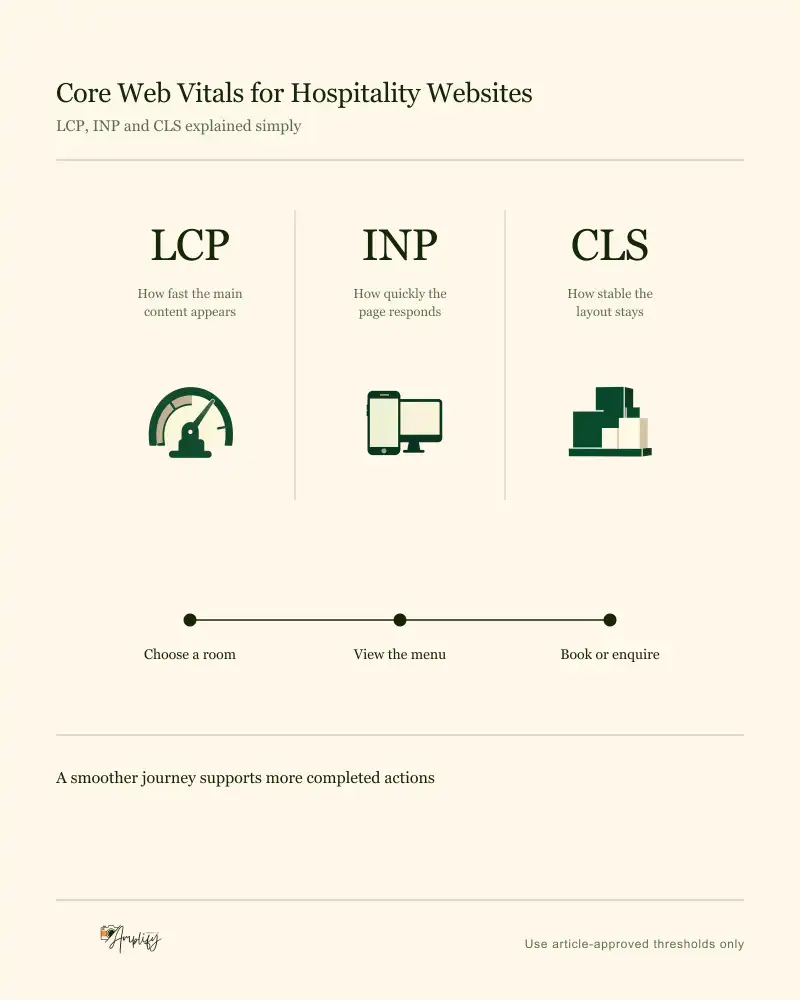
Core Web Vitals focus on three things: how fast key content appears, how stable the layout stays while loading, and how quickly the page responds to user input.
- Largest Contentful Paint (LCP): Measures how fast the main visible content loads. For hospitality sites, that is often a hero image, headline, or booking panel.
- Cumulative Layout Shift (CLS): Measures how much the page jumps around while loading. This is what causes accidental taps on menus, CTAs, or order buttons.
- Interaction to Next Paint (INP): Measures how responsive the page feels when someone taps, clicks, or types. Slow INP usually points to excessive JavaScript.
If you are still seeing older SEO advice that focuses on FID, treat it as outdated. Google now uses INP, which is a better reflection of how the site feels during real user interaction.
Why This Matters for Perth Hospitality
Hospitality customers are mobile-first. They search while walking through Northbridge, deciding where to eat in Fremantle, or checking a menu from the train. If your site feels slow on mobile data, your competitor gets the click.
A poor Core Web Vitals score usually shows up as one of these problems:
- Large hero images or galleries delaying the first meaningful view
- Menus and buttons shifting as fonts, images, or embeds finish loading
- Booking widgets, popups, or page-builder scripts making the site feel laggy
- Heavy image libraries that look good in print but are not prepared for web delivery
If the site ranks, poor vitals can still hurt conversion. If the site does not rank well, they become part of a wider technical drag on visibility. That is why they matter both for booking flow and for search performance.
How to Measure Your Site
Start with Google PageSpeed Insights and Chrome Lighthouse. They will show you whether the page is failing LCP, CLS, or INP and usually point to the major offenders.
If you want a more practical venue-focused view, our website design and development Perth and web development Perth services include audits that connect the technical issue back to the commercial consequence, not just the score.

Use Lighthouse or PageSpeed Insights to identify whether the main issue is loading, layout instability, or interactivity.
How to Improve LCP
LCP usually fails because the main image is too large, poorly compressed, or delayed by unnecessary code. Hospitality sites often make this worse by leading with full-screen photography that was never prepared for web delivery.
- Export hero images in modern formats like WebP and size them for real display widths
- Preload only the truly critical image, not the entire gallery
- Reduce render-blocking CSS and JavaScript above the fold
- Use a delivery setup that serves fast, responsive image sizes
If your visual library also needs work, read our case study on the ROI of professional food photography for Perth venues or scope a new image library through our food photography Perth service and menu photography Perth offer.
How to Improve CLS
CLS is the classic hospitality-site frustration: someone tries to tap the menu or booking button and the page shifts under their finger.
- Always define width and height on images and videos
- Reserve space for embeds, testimonials, and booking widgets
- Load custom fonts correctly so text does not reflow late
- Avoid injecting popups or banners above existing content during load
If your site relies on a builder or theme that constantly introduces layout shift, the right answer may be structural, not cosmetic.
How to Improve INP
INP problems usually come from JavaScript bloat: booking widgets, page-builder effects, sliders, reviews plugins, and tracking tools all competing for the browser.
- Remove scripts that are not tied to revenue or operations
- Delay non-essential widgets until after the main content is usable
- Replace bloated page-builder interactions with lighter implementations
- Keep the booking path simple and fast on mobile
If you are weighing a platform change, compare Astro vs WordPress for Perth hospitality websites. For a more technical workflow, read our Core Web Vitals developer playbook.
Patch or Rebuild?
Do not rebuild by default. Start by fixing the obvious issues: oversized images, layout instability, and unnecessary scripts. If those changes move the needle, keep iterating.
Rebuild when the underlying theme, plugin stack, or platform makes every performance improvement expensive, temporary, or fragile. That is often the point where a lighter architecture becomes the cheaper option overall.
The Photographer-Developer Advantage
Hospitality websites often fail because photography and development are handled in separate silos. One side delivers beautiful but heavy assets. The other compresses everything until the food looks flat and unappealing.
The better outcome is a workflow that plans the shoot, export settings, responsive delivery, and page layout together. That is how you get a site that looks premium and still performs well.
Next Step
If your venue site feels slow, unstable, or outdated, start with an audit. We will show you whether the right move is targeted remediation or a more deliberate rebuild.
Request a website performance audit and we will map the issues to what they are costing you in speed, usability, and search visibility.
Frequently Asked Questions
Tap through our website brief builder and we'll recommend the right next step.