
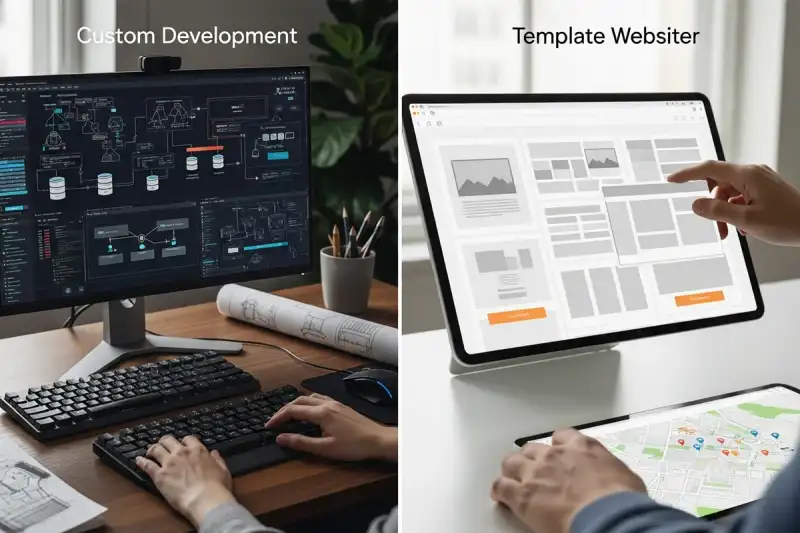
The real decision is not “cheap vs expensive”
When Perth business owners compare templates and custom builds, the conversation often starts in the wrong place. The first question is usually price. The better question is operational fit.
A template website is a pre-built system. It is useful when your offer is narrow, your content structure is simple, and your team needs to launch quickly. A custom website is a planned system. It is useful when the website needs to support more nuanced conversion paths, better technical SEO, or business-specific workflow.
That means both options can be correct. The mistake is choosing a template when the business already needs custom behaviour, or choosing custom when a focused template would do the job for another 12 to 18 months.
Fast comparison table
| Factor | Template site | Custom site |
|---|---|---|
| Launch speed | Fastest | Slower up front |
| Upfront cost | Lower | Higher |
| SEO control | Good for simple sites | Stronger for layered service architecture |
| Integration flexibility | Often limited | Built around your workflow |
| Content scalability | Can become messy as pages grow | Easier to structure for long-term expansion |
| Performance | Mixed, depends on theme quality | Easier to optimise deliberately |
| Total cost over time | Can rise if workarounds pile up | Higher upfront, often cleaner long-term |
Three common Perth business scenarios
1. Starter business
Think of a solo consultant, small trade business, or local operator in Joondalup with one clear offer and a modest budget. A template is often enough here if:
- the site only needs a homepage, service overview, about page, and contact
- there are no custom integrations beyond simple forms
- the business is not relying on a large SEO content strategy yet
In this case, custom development can be premature. The business usually gets better ROI from clear messaging, trust proof, and fast publishing rather than complex engineering.
2. Growth-stage service business
Now think of a Subiaco professional service or Perth CBD agency that needs multiple service pages, stronger authority signals, and better conversion sequencing. This is where templates start to struggle.
The moment you need:
- a clear offer ladder across several services
- deeper internal linking
- stronger page-speed control
- structured location proof
- a cleaner path from information page to commercial enquiry
the “cheap” build often stops being cheap. Custom development is usually justified because the business is already losing value to structure, not only design.
3. Multi-location or multi-offer business
This is the clearest custom-build case. If the business wants to expand service architecture, publish location-aware content, integrate sales or booking systems, or support multiple user journeys, a template normally becomes a constraint.
At that point, the website is not just a brochure. It is part of how the business acquires and manages demand.
When a template is still the right choice
Choose a template if most of the following are true:
- you need to launch inside 2 to 3 weeks
- the site will stay under 10 pages for the next year
- your team needs a very simple editing workflow
- you are not planning custom booking, CRM, or automation work
- your main goal is establishing a credible web presence, not scaling SEO depth
There is nothing wrong with that decision. The problem is pretending it will still be the right decision once the site starts carrying more commercial responsibility.
When custom development is justified
Choose custom development if several of these are already true:
- the business needs stronger service-page architecture
- lead quality depends on clearer qualification and page sequencing
- technical SEO matters across multiple topics or locations
- integrations will save real operational time
- performance is commercially important
- the current site is already causing workarounds
This is where a focused web development Perth service becomes a better investment than yet another round of theme edits.
The hidden cost most businesses miss
Template builds are often judged by launch cost. Custom builds are judged by quote size. That framing hides the biggest variable: rework.
If a business spends less upfront but then needs:
- another rebuild in 12 months
- paid traffic to compensate for weak organic structure
- manual admin because the site does not connect to systems cleanly
- extra developer time to keep patching a constrained setup
the original saving can disappear quickly.
That is why the real follow-up question is scope. If you need help with that, compare this article with our breakdown of website development cost in Perth and the publishing-model tradeoffs in WordPress vs headless CMS.
A simple decision rule
Use a template when the business is proving demand.
Use custom development when the website is already a bottleneck.
That bottleneck might be SEO depth, speed, conversion clarity, integrations, or editorial chaos. Once the bottleneck is real, engineering usually returns more value than another visual refresh.
Final take
Most Perth businesses do not need custom development on day one. But the right businesses absolutely need it once growth, trust, and operational workflow start depending on the website.
If you are unsure which stage you are in, start with the smallest honest answer. Then choose the system that still makes sense 12 months from now, not just the one that looks cheaper this week.
If you want a scoped recommendation, review our web development Perth service, then compare the numbers in our 2026 pricing guide and the CMS tradeoffs in this headless vs WordPress breakdown.