Venue event photography is easy to undervalue because most operators judge it like documentation. They think about whether the launch looked good on the night, not whether the image library will still be creating value six weeks later. That is the mistake.
For Perth hospitality venues, the stronger model is to treat event photography as a content system. A launch night, reopening, seasonal event, tasting, or brand activation should generate reusable visual assets that support social content, Google Business Profile updates, website refreshes, booking campaigns, and future event promotion.
This guide combines the opening-night planning angle with the 90-day repurposing framework into one practical playbook for venues that want better returns from a single shoot.
Why venue event photography should be planned like a campaign
A good event shoot does more than prove the venue was busy. It creates visual proof that the venue feels alive, credible, and worth booking. That proof is useful long after the event itself ends.
When the shoot is planned properly, the same library can support:
- launch recap content in the first few days after the event
- Google Business Profile freshness for local discovery and stronger venue presentation
- website upgrades across homepage hero sections, function pages, galleries, and about content
- ongoing social posts featuring dishes, drinks, crowd energy, and team moments
- press and partner outreach with ready-made imagery for features and collaborations
- future booking campaigns for private events, corporate functions, and seasonal promotions
Without that plan, venues usually post a handful of images immediately after the event and then stop. The content value dies because the asset library was never structured for reuse.
The core shift: from opening-night photos to a reusable asset library
The opening-night article answered an important question: why hire a photographer at all? The stronger question is what the venue gets after the files are delivered.
A useful event photography library should include both short-life and long-life assets:
- short-life assets: recap posts, attendee tags, launch buzz, same-week press and story content
- long-life assets: venue atmosphere, clean interiors, team imagery, detail shots, and branded moments that can live on the site or in future campaigns for months
That is why the brief should not focus only on “cover the night.” It should focus on “build the venue’s next content bank.”
What every Perth venue should capture during the event
The image mix matters more than the raw image count. A gallery full of similar crowd shots is less useful than a smaller set with real variety.
1. Pre-event venue hero shots
Capture the space before guests arrive. These frames often become the most reusable website and campaign assets because they show layout, styling, signage, lighting, and atmosphere without visual clutter.
2. Wide atmosphere coverage
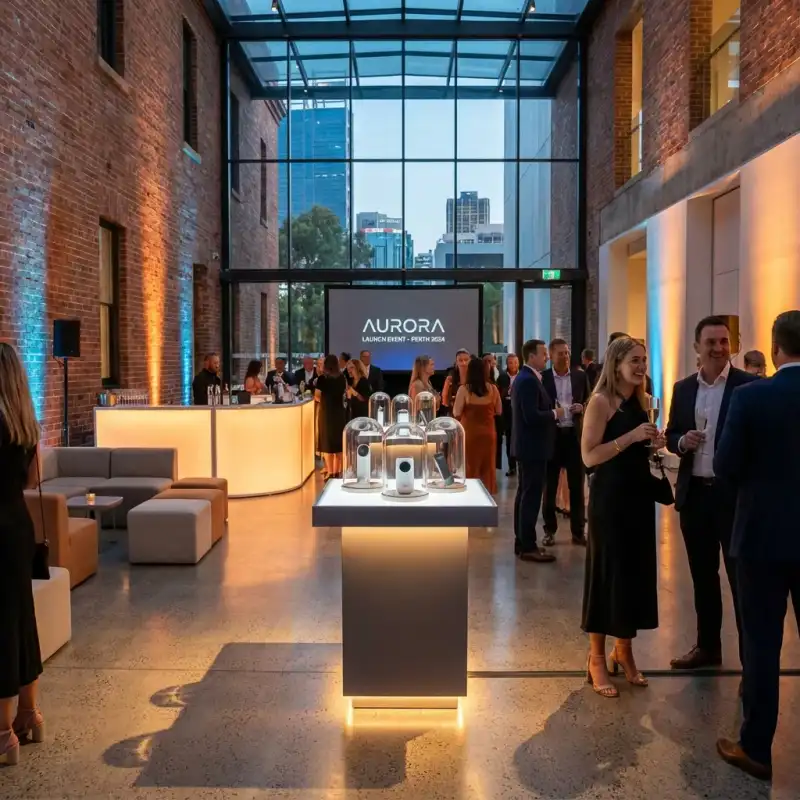
These images prove scale, energy, and social proof. They help future customers understand what the venue feels like when it is active, not empty.
3. Candid guest moments
Natural interaction beats posed imagery for hospitality. Guests laughing, toasting, ordering, and moving through the venue make the experience feel real.
4. Food and drink detail shots
Opening-night coverage should still include product-level assets. Signature dishes, cocktails, and hero menu details are often reused in later social campaigns and promotional pages.
5. Team and founder moments
Owners, chefs, floor staff, and bartenders give the venue a human layer. These images support about pages, PR use, and trust-building content.
6. Branded and contextual details
Menus, signage, lighting features, branded glassware, exterior context, and design details help the venue look distinct rather than generic.
A practical opening-night shot list
Before the event, most venues should prepare a short shot list that covers both the event itself and the later marketing uses. A simple baseline includes:
- exterior and arrival context
- empty venue hero frames
- owner or team welcome moments
- ribbon-cutting, speeches, or toast moments if relevant
- packed-room atmosphere
- signature cocktails and food highlights
- staff service moments
- VIPs, collaborators, or partner appearances
- vertical and horizontal versions of priority scenes
If the venue wants the images to support functions or private-event sales later, that should be in the brief too. The photographer needs to know the assets are meant to sell future bookings, not just recap the launch.
The 90-day rollout after the event
Most venues do not need more photos immediately. They need a clearer deployment plan. A basic 90-day structure is usually enough.
Week 1-2: launch momentum
- publish recap posts and thank-you content
- refresh Google Business Profile with the strongest atmosphere and detail shots
- update homepage and key landing pages with new hero imagery
- send an email recap or launch follow-up to the list
- share media-ready images with collaborators or local press
Week 3-8: controlled reuse
- turn food and drink images into individual feature posts
- run team or founder spotlights using candid staff moments
- reuse venue detail imagery for quieter posting weeks
- build campaign creative for bookings, functions, or seasonal offers
Month 3 and beyond: evergreen support
- keep the best venue images on core website pages
- refresh Google Business Profile again with a second batch
- reuse crowd and atmosphere images in event-packages or functions pages
- bring strong frames back for throwback content, seasonal promotions, and paid campaigns
The main point is simple: the event is short, but the asset library should keep working.
Where the ROI usually appears first
Venues often expect the return to show up only on Instagram. That is too narrow. The ROI usually spreads across several channels at once:
| Channel | How the images help | Typical early outcome |
|---|---|---|
| Google Business Profile | Fresh venue imagery improves presentation and trust in local search | Stronger profile engagement and more useful listing coverage |
| Website | Better hero sections, galleries, and function pages | Stronger first impression and lower visual friction |
| Social media | Consistent content from one real event | Better engagement than ad hoc phone content |
| Email and CRM | Campaigns feel more current and venue-specific | Higher click interest on launches and offers |
| Press and partnerships | Ready-to-use assets for features and cross-promotion | Less delay and stronger brand presentation |
| Future bookings | Proof that the venue can host lively, polished events | More useful sales material for functions and private hire |
If you want the website side to hold up after the shoot, pair this with our guide to restaurant website checklist and conversion essentials.
Common mistakes that waste the value of the shoot
1. No pre-event brief
If the photographer is only told to “capture the night,” the result is usually generic coverage. The marketing uses need to be clear before the event starts.
2. No empty-venue coverage
Busy atmosphere shots matter, but clean hero frames are often the most reusable files for websites, brochures, and booking collateral.
3. No platform-aware exports
Venues often receive a gallery but no system for web-ready, social-ready, or profile-ready usage. That creates friction and delays deployment.
4. Using the best images once
The strongest images should not be burned in the first week. Good libraries are staged across campaigns, not exhausted on day two.
5. Treating the event as isolated from the wider launch
Launch-night photography works best when it connects to the website, Google presence, email capture, and future campaign planning. If those systems are disconnected, the venue leaves value on the table.
For broader launch sequencing, pair this with our WA brand launch guide.
What to look for in a photographer if the goal is long-term content value
Venues do not just need someone who can cover a room. They need someone who understands how the files will be used later.
- hospitality awareness: the photographer understands service flow, food and drink timing, and atmosphere
- low-light capability: many venues are dark, warm, and difficult to cover well
- marketing context: they ask how the venue will use the images after delivery
- fast turnaround: launch momentum is lost if the files arrive too late
- usable delivery: the gallery is organised enough to support web, social, and profile deployment quickly
If the venue also needs corporate, private, or brand-event coverage beyond hospitality, our Perth event photography service outlines the broader coverage scope.
How this supports functions, reopenings, and future campaigns
The merged value of these two original articles is not limited to opening nights. The same model applies to venue anniversaries, seasonal launches, collaborations, tasting menus, refurbishments, and reopening campaigns.
Any event that shows the venue at full energy can become a reusable proof asset. That is why venue event photography should sit inside the content system, not outside it.
Final takeaway
Hiring a photographer for a venue event only makes sense if the shoot produces more than memories. The real commercial gain comes when one event gives the venue a usable image library that supports local discovery, stronger website presentation, ongoing social output, and future booking campaigns.
That is the standard Perth venues should work to: not “Did we get some nice launch photos?” but “Did we build the next three months of visual marketing in one night?”
For venues planning the wider digital stack around that launch, continue with how to build a pre-launch landing page that captures emails and Google Maps SEO for Perth venues.