
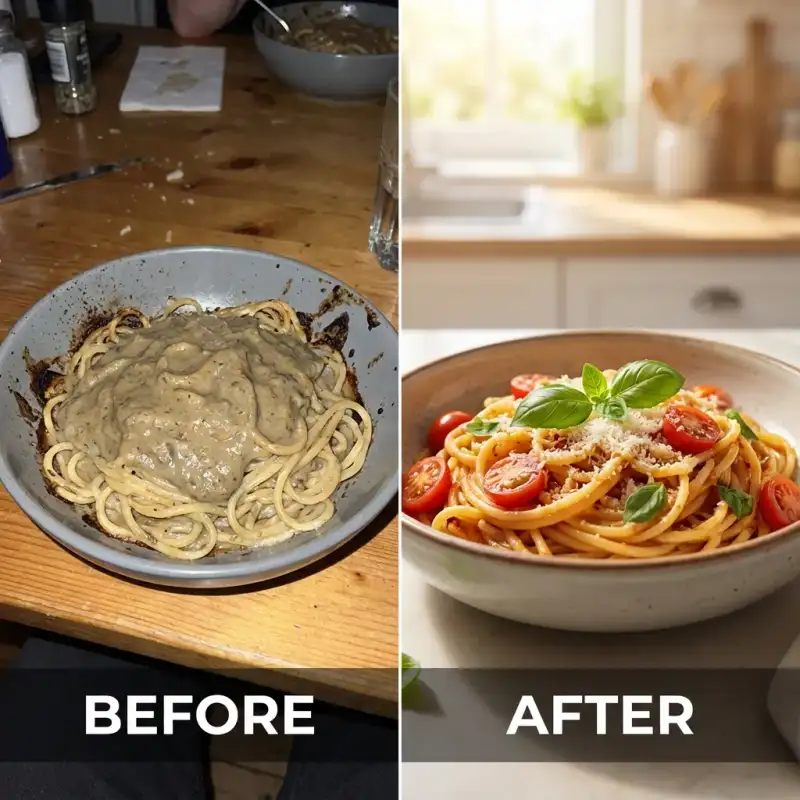
Professional food photography pays off when it changes customer behavior, not just when it looks better. For Perth venues, that usually means more clicks from Google and delivery platforms, stronger confidence in premium dishes, higher engagement on menu pages, and a more credible brand across every place customers compare options.
This guide combines the ROI case with the before-and-after mistakes analysis into one commercial view. It explains what bad imagery is costing, which mistakes matter most, and where the gains from professional food photography typically show up.
Why bad food photos cost more than most venues expect
Customers make fast decisions. On Google Business Profile, Uber Eats, Menulog, and restaurant websites, the image often lands before the copy. If the photo looks flat, yellow, blurry, or inconsistent, the venue feels lower quality before the customer reads a word.
That visual penalty usually shows up in a few predictable ways:
- Lower click-through: customers choose the venue whose dishes look more desirable.
- Lower perceived value: premium pricing becomes harder to justify when the visuals feel cheap.
- Weaker menu conversion: customers hesitate on dishes they cannot assess properly.
- Wasted traffic: paid clicks, local-search traffic, and social attention convert worse when the images underperform.
That is why the ROI conversation should not start with “What does a shoot cost?” It should start with “What do weak visuals keep costing every week?”
The five mistakes that hurt conversion most
1. Poor lighting
Harsh kitchen lighting, yellow casts, or muddy shadows flatten texture and make food feel stale rather than fresh. Lighting problems are often the fastest way to kill appetite appeal.
2. Weak composition
Awkward crops, the wrong camera angle, or distracting objects in frame stop the dish from feeling like the hero. Customers should understand the product instantly.
3. Inconsistent styling
When every dish looks like it came from a different venue, the brand starts to feel unstructured. Consistent styling does not mean everything looks identical. It means the visual system feels intentional.
4. Low-resolution or badly exported files
Grainy or over-compressed images damage credibility. The opposite problem is also common: oversized files that look good but slow pages down and weaken the browsing experience.
5. No platform-aware delivery
Food photos should not be treated as one-size-fits-all assets. Websites, Google listings, delivery apps, and social platforms all crop and display imagery differently. Good production includes the export strategy, not just the shoot.
If you want a deeper platform workflow, pair this guide with how to use food photography across website, Instagram, and Uber Eats.
What before-and-after improvement actually looks like
Most venues have already seen the problem in their own content library. A smartphone photo taken during service often has messy framing, mixed lighting, and weak plate presentation. The professional version of the same dish usually changes three things at once: lighting control, styling discipline, and image usability across channels.
The difference is not abstract. A better image usually creates clearer appetite cues, more trust in the kitchen, and a stronger sense that the dish is worth ordering now rather than later.
Typical “before” problems
- yellow or green colour casts from ambient lighting
- background clutter competing with the dish
- no clear focus on the hero ingredient or plating detail
- compression damage from repeated exports and uploads
Typical “after” improvements
- cleaner, more appetising light on texture and steam
- better control of garnish, plate edges, and props
- angles chosen for the dish rather than whatever was convenient
- deliverables prepared correctly for web, Maps, and campaign use
That before-and-after shift is where the ROI starts. Customers are not just reacting to prettier photos. They are reacting to clearer evidence that the food, venue, and overall experience are worth paying for.
Where the ROI shows up first
Menu and website pages
Better dish imagery tends to hold attention longer and supports stronger choices on signature and premium items. That is why photography pairs so well with menu engineering.
Google Business Profile and Maps
When customers compare venues locally, the image quality on the listing heavily shapes first impressions. Better owner photos also support a more active, trustworthy profile.
Delivery platforms
These environments are brutally comparative. Customers are often deciding between similar options in seconds, so weak imagery loses fast. This also matters if you are trying to reduce commission dependence later through direct-order growth. See our guide on photography and delivery-platform margin.
Social and launch content
One well-planned shoot produces ongoing marketing assets, not just menu images. That broader reuse is a major part of the return because the same visual system keeps working long after the shoot day ends.
How to think about ROI without fake precision
The real return is rarely one single metric. It is usually the combined lift from a stronger first impression, better premium-item conversion, more reusable assets, and less inconsistency across channels.
A practical way to evaluate the investment is to ask:
- Are high-value dishes underperforming because customers cannot see the difference?
- Do website and delivery-platform images feel weaker than competitors in the same Perth suburb or category?
- Does the venue keep reusing old photos because there is no reliable asset bank?
- Are paid campaigns or seasonal launches built on weak creative?
If the answer is yes to several of those, the photography problem is already commercial, not cosmetic.
When DIY stops making sense
DIY content can be useful for day-to-day social updates, but it usually becomes limiting when the same images need to carry the website, Maps, media coverage, and paid content all at once.
The threshold is usually not camera quality. It is consistency, lighting control, styling discipline, and production readiness. Once those matter, a professional shoot tends to outperform the cycle of constant patch fixes and inconsistent uploads.
How to maximise the return from one shoot
The best ROI does not come from photographing everything. It comes from photographing the right things well and planning reuse before the day starts.
- Prioritise signature dishes and profitable items rather than trying to cover the full menu equally.
- Capture atmosphere and team imagery too so the session supports more than menu pages.
- Prepare the kitchen and shot list in advance to protect production time. Our kitchen prep guide covers this.
- Export for each destination properly so quality and site speed both stay strong.
That approach creates a useful asset system rather than a folder of nice-looking files that never gets used consistently.
What this means for Perth venues
In Perth’s hospitality market, professional food photography is usually one of the highest-leverage visual upgrades a venue can make because it influences both discovery and conversion. It affects how customers judge your food, how your menu performs, how your listing competes locally, and how much usable marketing content your team has after the shoot.
If your current imagery is holding back bookings, orders, or premium-item performance, the problem is probably bigger than one bad photo. It is usually a broken visual system.
For help planning a session that works across menus, websites, Maps, and delivery platforms, see our Perth food photography service or get in touch.
Related guides: How to Use Food Photography Across Website, Instagram, and Uber Eats | How to Prepare Your Kitchen for a Successful Food Shoot