
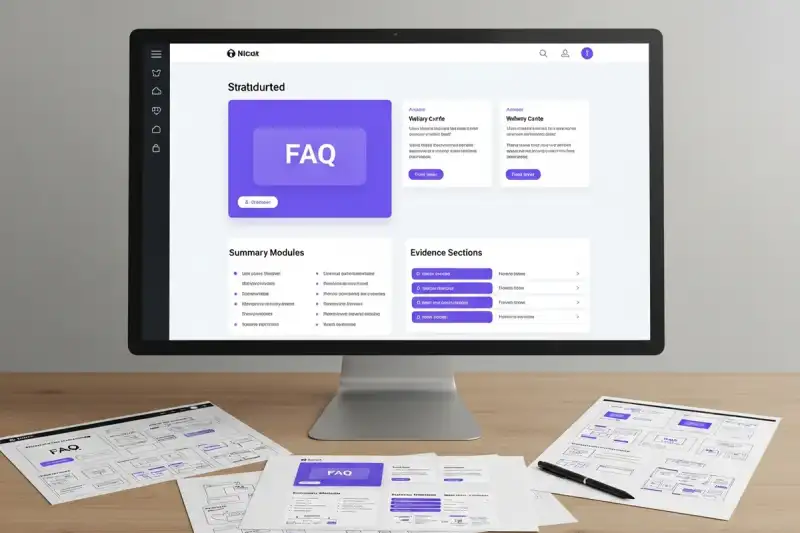
Why AI search changes page design priorities
Search is shifting from ten blue links toward summarised answers, cited snippets, and assistant-led recommendations. That does not replace traditional SEO, but it does change what a strong page looks like.
A page that ranks reasonably well but explains itself poorly is harder for AI systems to summarise cleanly. A page with clear structure, concise answers, and stable terminology is easier to retrieve and cite.
That is why GEO-ready page structure is now part of good web design, not just content strategy.
The page patterns AI systems read most easily
Concise answer blocks
Put short, direct answers near the top of the page for key questions such as cost, timeline, service scope, and expected outcomes. The same idea already improves human scanning and is one reason conversion-focused page structure overlaps so strongly with GEO.
Stable heading hierarchy
Pages should move from broad context to specific answers in a predictable order. Random headline jumps and vague section names make extraction harder.
Evidence modules
AI systems are more likely to trust and summarise pages that include visible proof signals such as process detail, examples, FAQs, comparison tables, and clearly framed outcomes.
Clear entity language
If your business offers web design in Perth, keep that terminology consistent across page title, body copy, FAQs, schema, and internal links. Do not rename the same service three different ways just to sound varied.
What weak GEO pages usually look like
Weak pages often:
- bury core answers under long introductions
- use vague headings such as “Why choose us”
- hide process and pricing guidance
- mix inconsistent service names
- rely on design flair where clarity should do the work
These issues also hurt human usability. That is why many businesses improve both SEO and AI-answer readiness when they revisit the same fundamentals covered in performance-focused page design and clearer UX structure.
A practical implementation checklist
For any service page, make sure you can identify:
- what the service is
- who it is for
- where it is offered
- typical cost or pricing model
- delivery timeline
- process steps
- proof or examples
- FAQ answers in plain language
If a visitor has to dig too far to find those, AI systems will struggle too.
Final take
GEO-ready design is mostly disciplined information architecture. It is not about writing for robots. It is about making service pages so clear that both humans and retrieval systems can understand them quickly.
If you want better AI-answer visibility, start by making your service pages easier to scan, easier to cite, and easier to trust. That work belongs inside your web design strategy, not as a separate layer added later.