If your product images are helping the business sell, the question is not “can we shoot these ourselves?” It is “what level of image quality and consistency does the business now need?” When the answer is reliable conversion across web, marketplace, and campaign channels, that is usually where professional product photography in Perth becomes the better commercial move.
DIY can work, but only for specific jobs
DIY product photography is useful when speed matters more than polish. A clean iPhone shot can be enough to test a new product, fill a social-content gap, or create a temporary listing while the business proves demand.
Problems start when those “temporary” images become the long-term catalog. The store begins to feel uneven. Colors drift. Framing changes. Some products look premium, others look improvised. That inconsistency quietly lowers trust before the price or offer even gets evaluated.
Where DIY still makes sense
- Early-stage testing: you need images live quickly before committing to a full shoot.
- Behind-the-scenes and social content: speed and authenticity matter more than catalog perfection.
- Low-volume marketplace selling: a simple repeatable setup can be enough for occasional listings.
- Interim launch content: you need temporary visuals while preparing a proper production run.
If that is your current stage, use a repeatable prep guide before the camera comes out. DIY fails fastest when the products are not clean, the shot list is vague, and the setup changes halfway through the session.
What an iPhone and DIY setup can realistically deliver
An iPhone is not the problem. Uncontrolled production is. With a tripod, two diffused lights, a simple sweep background, and one consistent framing system, a phone can create useful images for low-risk work.
- Good enough: social posts, test listings, and simple products with matte surfaces.
- Usually weak: reflective packaging, detailed labels, larger catalogs, and products where accurate color is critical.
- Expensive to maintain at scale: any workflow that requires frequent re-shooting, cleanup, and manual corrections.
This is the breakpoint many brands miss. The first 10 products might feel manageable. The next 50 expose whether the setup is really repeatable.
The cost comparison is wider than gear versus booking fee
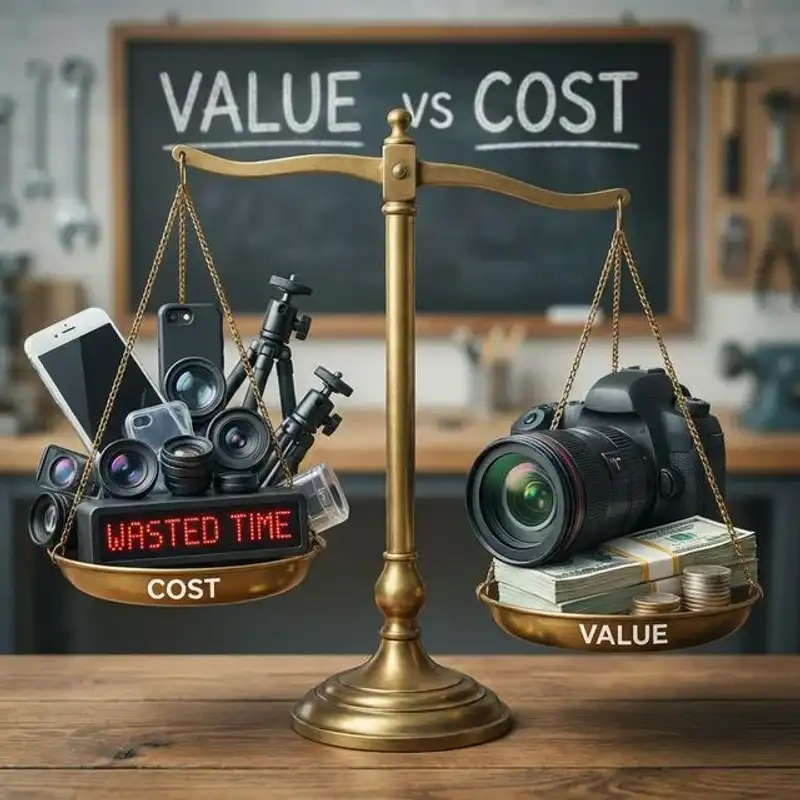
Most DIY calculations stop at lights, background, tripod, and editing software. That misses the larger cost centers: setup time, shooting time, editing time, re-shoots, and the commercial drag caused by weaker images.
- Gear cost: relatively low and usually not the problem.
- Owner or team time: the part most businesses underprice.
- Catalog inconsistency: the hidden trust leak that lowers perceived product quality.
- Conversion drag: product pages work harder when the visuals do less selling.
If you want the numbers behind those trade-offs, pair this article with our 2026 product photography pricing guide. That gives the service-side budget. This article covers the decision logic around whether the business should still be doing it in-house at all.
When professional photography starts making more sense
The switch usually happens when images stop being simple content and start acting as infrastructure for revenue.
- The store is running paid traffic: weak imagery wastes every click.
- The catalog is growing: repeatability matters more than one-off creativity.
- Products are premium or detail-heavy: perceived quality depends on stronger image control.
- Marketplaces or wholesale channels are involved: compliance and consistency become operational requirements.
- The team keeps reshooting: the workflow is no longer saving time.
That is also where the visual layer starts affecting broader business outcomes. Our visual-assets conversion guide explains how better imagery changes trust, perceived value, and purchase confidence across ecommerce pages.
The hybrid model is often the smartest option
For many Perth brands, the best answer is not purely DIY or purely professional. It is a divided workflow.
- Professional shoots: core ecommerce listings, ads, hero images, new collections, and launch campaigns.
- DIY production: Stories, quick updates, behind-the-scenes content, and lower-risk social outputs between campaigns.
This model keeps the storefront and paid channels strong while still giving the internal team speed where polish is less critical. It is also the most realistic path for small brands that need quality without trying to solve every content need through one expensive production day.
A practical decision framework
Stay DIY if:
- You are validating demand and still moving quickly.
- You have a small SKU count and simple products.
- Your current need is mostly social or low-risk marketplace content.
Go hybrid if:
- You need strong ecommerce images but still post content frequently in-house.
- You want to upgrade top sellers first without photographing the full catalog immediately.
- You need a system that supports both launch assets and ongoing content velocity.
Go professional-first if:
- The store already depends on conversion performance.
- You are selling premium, reflective, or compliance-heavy products.
- You are scaling into ads, wholesale, or national distribution.
If budget is the main concern, our small-business product photography guide lays out how to stage that upgrade without trying to shoot everything at once.
Better images are usually cheaper than another month of weak ones
The longer the business relies on images that are merely “good enough,” the longer the catalog, ad creative, and product pages keep underperforming. That is why the real decision is rarely about camera quality alone. It is about whether the current workflow is still commercially fit for purpose.
If you want help deciding where that line is, get in touch. We can review your current image system, identify where DIY is still fine, and scope a production plan around the products and channels that matter most.
See our product photography service, our pricing guide, and our marketplace photography tips.