The wrong question most businesses ask
Perth businesses often ask, “What is the cheapest way to get a website live?” That is understandable, but it is usually the wrong question. The better question is, “What type of site will still help us in 12 to 24 months?”
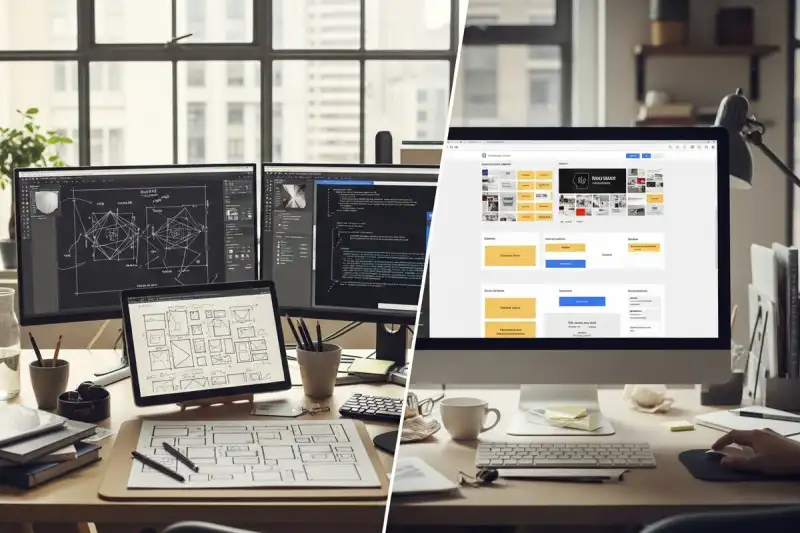
That is where the custom-versus-template choice becomes important. A template can launch faster. A custom site can align more closely with your offer, your conversion funnel, and your search strategy. The right answer depends on what the website needs to do.
If your current site already feels boxed in, that usually points toward a redesign rather than another patch.
When a template is good enough
Templates work best when:
- the site is small
- the content model is simple
- differentiation is not a major requirement
- budget is the primary constraint
For a new venture testing an idea, that can be enough. But even here, the template only works if the content is disciplined and the layout is simplified. A template overloaded with sections, effects, and plugins becomes fragile quickly.
Where templates usually start costing you
1. Messaging fit
Templates are designed to suit everybody, which means they fit nobody particularly well. Your headings, trust proof, offer ladder, and page sequence often get forced into generic layout blocks.
2. Performance debt
Many template stacks ship with code and features you do not need. That hurts responsiveness, especially on mobile. If speed and usability are already slipping, review the same performance issues discussed in our Core Web Vitals guide.
3. SEO limitations
Templates can publish pages, but they often make it harder to build a clean topical cluster, focused landing pages, or service pages with strong hierarchy. SEO problems rarely come from one missing tag; they come from a site structure that never really matched intent in the first place.
4. Growth friction
Once you need custom service flows, campaign landing pages, or more deliberate UX pathways, the template starts fighting you. That is when businesses end up paying twice: once to launch and again to rebuild.
What custom design actually buys you
Custom web design is not about making everything unusual for the sake of it. It is about aligning the site with how your business actually sells.
That usually means:
- clearer information hierarchy
- page types designed around specific intent
- performance choices made on purpose
- room for landing pages, new services, and SEO expansion
- a stronger connection between design and conversion
This is especially relevant when the site needs to support multiple pathways such as service pages, audit offers, and local search content. That is where a more strategic web design approach tends to outperform a theme-driven build.
A simple ROI matrix
Choose a template when:
- you need a basic site live quickly
- the site is unlikely to expand much
- budget is the primary constraint
Choose custom when:
- the site needs to generate leads consistently
- the business has multiple services or campaign flows
- conversion rate matters as much as appearance
- you expect to expand content and offers over time
If the website is becoming a primary sales channel, custom usually wins on ROI because it reduces compromise where it matters most.
Final take
Templates are not bad. They are just limited. For a simple launch, that limitation may be acceptable. For a growing business, it often becomes the reason the next rebuild happens sooner than expected.
If your site needs better hierarchy, clearer conversion pathways, or room to scale, start with a custom web design plan and review how reusable structure supports growth in our design systems guide.